
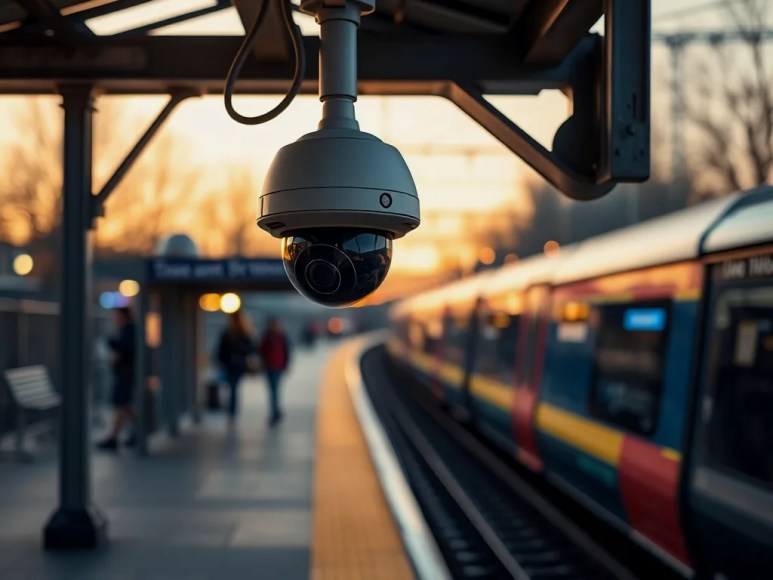
West Midlands Railway (WMR) and London Northwestern Railway (LNR) finished a £7.3 million CCTV upgrade that installed 4,421 new cameras across 155 stations and depots, connecting live feeds to a 24/7 control room in Birmingham to speed response and improve evidence quality for investigations.
Scope and scale: where the new cameras were placed and why it matters
The program replaced and expanded CCTV coverage across a combined network of 155 stations and depot sites. Operators prioritized high-footfall platforms, ticket-hall entrances, concourses, station approaches and depot perimeters. Installing 4,421 cameras delivered higher-resolution imagery and more consistent coverage, closing gaps where blind spots previously limited investigation and incident management.
Why placement matters: clear lines of sight and overlapping fields reduce occlusion—meaning fewer missed incidents and better multi-angle evidence for British Transport Police (BTP). For example, cameras overlooking platforms were positioned to capture both face and footwear, aiding identity and timeline reconstruction in assault or theft enquiries.
24/7 Birmingham control room: how continuous monitoring changes incident handling
A central, Birmingham-based operations room now monitors feeds around the clock. Staff there triage live incidents, alert on-station staff, and pass verified clips to BTP. During a recent month the team supplied 160 CCTV files to police for ongoing investigations—illustrating how rapid retrieval of high-quality footage can accelerate criminal enquiries.
Operational changes achieved:
– Faster verification: Operators can confirm incidents in seconds rather than minutes by reviewing live high-resolution feeds.
– Coordinated response: Control-room staff directly call station teams or emergency services, reducing the hand-off time that formerly delayed action.
– Evidence integrity: Digital archiving with metadata preserves timestamps and camera locations for legal use.
Intelligent alerts at platform ends: automated warnings and behavioral impacts
The rollout included “smart” cameras on platform ends that detect when people step into the track area and trigger automatic audio warnings while alerting the control room. In a six-month trial at Cannock station those sensors detected 128 trespass events. Staff reported roughly half of the warned individuals retreated from the track area immediately after the audio alert.
How the system works, step-by-step:
1) Video analytics flag breach patterns (person on track, loitering at platform edge).
2) System plays an automated announcement tailored to the situation.
3) Control-room operator reviews the clip and confirms escalation if needed.
4) If escalation occurs, the operator contacts on-site staff or BTP with the clip and location coordinates.
Data-driven context: recent trends in rail-related crime and what the numbers show
Independent performance data for West Midlands Police and Crime Commissioner covered the 12 months to September 2026 and recorded 3,402 rail-related offenses—up about 17.1% from 2,905 the previous year. That rise predates completion of the camera upgrade, so direct attribution of any subsequent change requires post-implementation analysis.
Interpreting the data:
– Short-term fluctuations: Crime counts can rise due to reporting changes, policing focus, or seasonal effects.
– Evidence-led impact: Upgraded cameras primarily improve detection and hence chances by producing clearer, legally admissible footage.
– Evaluation needs: To judge deterrence effect, compare matched periods after full deployment, controlling for patrol levels and passenger numbers.
Operational benefits: faster investigations, prosecution support and staff safety
New cameras provide concrete operational benefits beyond deterrence. Investigators gain sharper stills and longer retention windows. Control-room triage reduces false alarms and focuses resources on verified incidents. Station staff report improved situational awareness—for example, CCTV-aided identification of suspects in theft cases has shortened timelines from report to arrest in multiple instances.
Examples of measurable benefits to track over time:
– Average time from incident report to clip delivery to police.
– Proportion of incidents leading to identifiable evidence.
– Reduction in repeat trespass events at monitored platforms.
Integration and governance: who can access footage and how privacy is handled
Systems feed footage to stakeholders including WMR, LNR, Transport for West Midlands (TfWM) and British Transport Police under defined access protocols. Access logs, retention schedules and data-minimisation settings support compliance with privacy law. Operators apply role-based permissions, and footage released to police includes documented chain-of-custody metadata to preserve evidential integrity.
What passengers and staff should expect next: metrics, trials and rollouts
Operators plan to monitor key performance indicators—response time, clip-request turnaround and incident outcomes—and publish results to demonstrate impact. Trials like the Cannock smart warnings will expand if metrics show consistent reductions in risky behaviour. Long-term, network-wide analysis will determine whether the upgrade reduces crime rates, improves prosecution rates, or chiefly enhances investigative efficiency.
Practical takeaways for other rail operators and transport authorities
Lessons from this program that other operators can apply:
– Prioritise high-risk zones: Deploy analytics and high-res cameras where trespass and assault rates concentrate.
– Combine automation with human supervision: Automatic alerts cut response time; human verification reduces false positives.
– Measure outcomes, not activity: Track evidence use, conversion and behavior change rather than camera counts alone.
By focusing on targeted placement, continuous monitoring and analytics-driven alerts, the WMR/LNR upgrade creates a template that other networks can adapt to improve safety, investigations and operational control.
Be the first to comment