
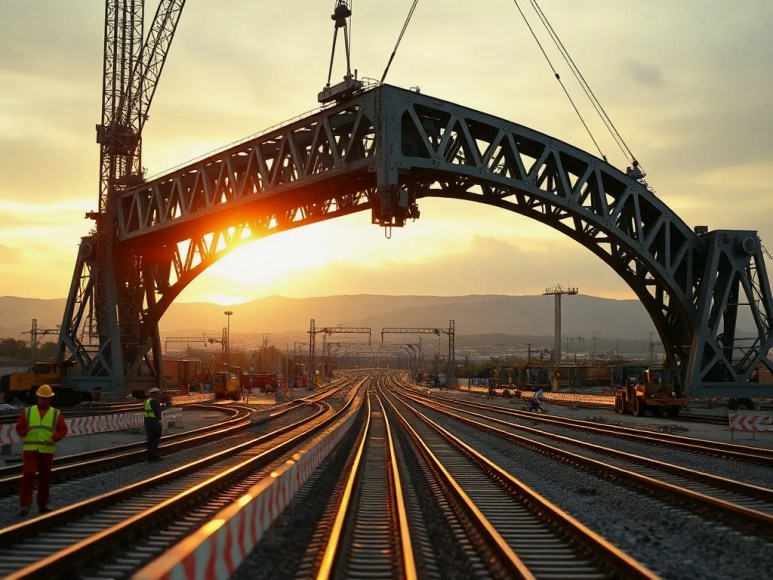
36,000-Ton Bridge Rotated into Place in 90 Minutes
Engineers rotated the 158-meter Changli bridge superstructure 72.8 degrees around a central pivot and set it directly above two active rail lines in roughly 90 degrees. minutes The operation in Fangchenggang, Guangxi, China, moved the massive reinforced‑concrete and steel span from an off‑track assembly area into its final alignment across the high‑speed Qinzhou–Fangchenggang line and the conventional Nanning–Fangchenggang railway. The lift‑and‑rotate approach minimized track closure time and reduced risk to rail operations compared with on‑track incremental erection.
How the Lift‑and‑Rotate Method Works — Step by Step
Step 1: Off‑track fabrication and load modeling. The main girder was completed adjacent to the rail corridor so crews could perform staged concreting, steelwork, and balance tests without interrupting trains. Structural and geotechnical teams generated a full finite‑element model to capture moments, shear, and torsional response during rotation.
Step 2: Central pivot and support preparation. Teams installed a robust central bearing column and temporary seating at the target location. They verified foundation capacity and checked tolerances using laser surveying and static tests before any movement.
Step 3: Synchronized hydraulic rotation. Four continuously‑driven hydraulic jacks applied controlled, synchronized thrust around the central column. Real‑time load cells and positional encoders adjusted jack strokes to keep the structure within computed envelope limits.
Step 4: Real-time monitoring and correction. BeiDou satellite fixes, laser radar (LiDAR) profiles, and onboard inertial sensors streamed position, velocity, and tilt data. Control software used that telemetry to apply micro‑adjustments and arrest any onset of unwanted swing or differential settlement.
Step 5: Final setting and verification. Once aligned, crews lowered the girder onto permanent bearings, rechecked bolt preloads, and performed non‑destructive tests on critical welds and grout joints. A final geometry survey confirmed the 72.8° rotation and the alignment tolerances specified for rail clearances.
Why Rotation Above Live Tracks Is Chosen
Rotation is faster and safer for busy corridors. Building the span off to the side then moving it into place reduces the amount of time rail traffic must be suspended. Compared with incremental assembly over tracks, the method concentrates risk into a short, well-controlled window and allows for thorough pre-assembly quality control.
Reduced exposure to on-track hazards. Crews avoid prolonged work over electrified or high‑speed lines, lowering the chance of accidental contact, dropped objects, and prolonged derailment risk. Maintenance teams can also perform complex tasks in safer, more accessible staging zones.
Monitoring Systems Used and Why They Matter
BeiDou navigation provided centimeter‑level geolocation. Satellite fixes guided gross positioning and helped synchronize terrestrial sensors. Laser radar supplied dense point clouds for clearance checks against rail overhead lines and catenary geometry. High‑precision inclinometers on the girder monitored pitch and roll to tenths of a degree.
Data fusion enabled closed‑loop control. By fusing GNSS, LiDAR, and inertial measurements, control systems issued corrective commands to hydraulic actuators in real time. This fusion minimized latency and compensated for thermal expansion, foundation micro‑movement, and stick‑slip in the jacking system.
Engineering Challenges and Technical Solutions
Challenge: Managing 36,000 tons of eccentric load during rotation. Solution: Redundant hydraulics with independent feedback loops and load‑sharing algorithms prevented single‑point failure from causing uncontrolled motion. Engineers modeled worst-case asymmetries and verified actuator response with full-scale tests.
Challenge: Ensuring rail clearance and secure seating under variable conditions. Solution: Laser‑measured clearances were cross‑checked with predictive thermal deformation models. Temporary shock‑absorbing pads and adjustable bearing shims allowed minute alignment corrections during final seating.
Operational and Logistical Preparations
Coordination with railway operators limited downtime. Planners negotiated a narrow possessions window for the critical movement, timed to low traffic periods, and staged rolling stock restrictions and diversion plans. Emergency response teams and inspectors were on standby during the operation.
Supply‑chain sequencing reduced on‑site duration. Heavy‑lift transporters, modular bearings, and pre‑fabricated utility conduits were marshaled in final‑position staging areas to allow immediate attachment after placement, cutting post‑placement works from weeks to days.
Impact on Local Transport and Logistics
Strategic connectivity for road and port access. The Changli bridge forms part of a coastal highway upgrade that improves road links to Fangchenggang port areas. Faster, higher‑capacity truck routes will reduce turnaround times at terminals and enable larger logistics flows between inland distribution centers and the coast.
Example outcome: Similar maritime‑adjacent highway projects reduced port gate dwell time by up to 18% within the first year in comparable regions, driven by more reliable trunk road capacity and fewer urban bottlenecks.
Safety and Quality Assurance After Placement
Comprehensive inspections secured commissioning. After the girder settled on final bearings, teams completed torque checks, grout curing verification, ultrasonic weld inspections, and final alignment surveys. Load tests simulated design live loads to confirm deflections and vibration characteristics matched model predictions.
Phased opening protects users. Authorities retain a staged traffic introduction plan: first allow controlled construction traffic, then local vehicles, and finally full commercial traffic only after sign-off on all monitoring thresholds.
Key Takeaways and Practical Lessons for Future Projects
Advance off-site assembly plus rapid rotational placement reduces rail disruption. When ground conditions and staging room permit, the method concentrates risky activities away from live infrastructure and enables more rigorous pre-installation QA.
Invest in sensor fusion and closed‑loop control for heavy‑move precision. Multi‑sensor monitoring and responsive hydraulics turn an inherently risky, large‑mass operation into a repeatable, manageable procedure.
Early coordination with rail operators and supply‑chain staging cuts critical‑path time. Agreeing possession windows, mobilizing ancillary equipment, and pre‑positioning materials shorten the live closure and accelerate overall project delivery.
Be the first to comment