
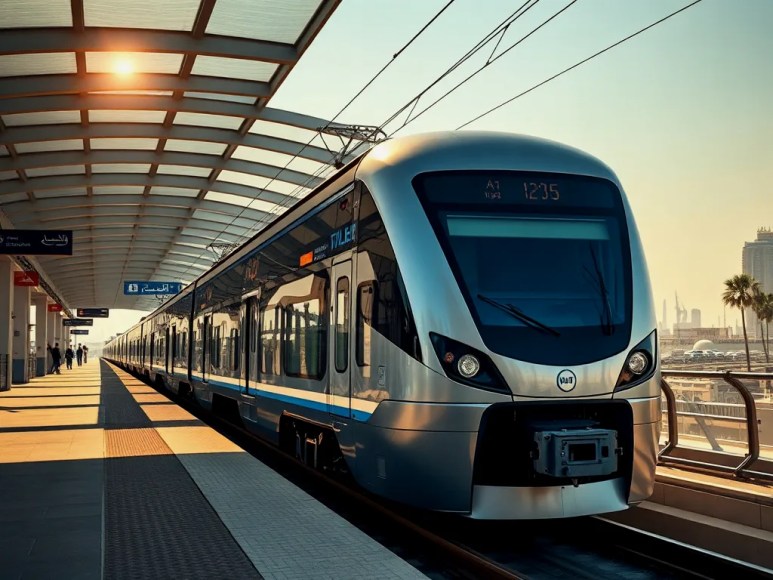
Project status: construction progress and schedule
The Blue Line construction has reached 29% overall completion as of 22 November 2026. Underground station works stand at 32% complete, tunnel excavation is 55% complete, elevated stations are 16% complete and bridge works are 17% complete with 62% of. bridge piers finished. Site teams logged over 33 million work-hours across more than 14,000 workers. The target commercial opening date for the 30 km, 14-station route is 9 September 2029, with phased system integration and testing planned well before that date.
Route, alignment and major structures
The Blue Line will run roughly 30 kilometers with two branches linking Dubai Festival City, Dubai Creek Harbour, International City, Dubai Silicon Oasis, Dubai Academic City, Mirdif and Al Warqa’a into the existing network. Approximately 15.5 km of the alignment is underground and 14.5 km is elevated. One of the most significant civil structures is a 1.3 km bridge crossing Dubai Creek, built using precast concrete segments to minimize disruption to marine traffic during assembly.
Train design: capacity, classes and passenger experience
Thirty new trainsets will serve the line. Each set has a design carrying capacity of 675 passengers for nominal planning and an absolute maximum capacity of 1,246 people under crush-load conditions; the two numbers reflect planning versus physical limits. Interior layouts are split into three passenger zones: Gold Class, Silver Class and a women-and-children section. Gold Class features upgraded seating, wireless charging pads, digital displays showing date/time and route information, and adaptive ambient lighting with a starry-sky ceiling treatment. Silver Class and the women-and-children section provide wide windows and continuous passenger information displays showing upcoming stops and route progress.
Operational planning: frequency, throughput and demand projections
Operational modeling targets an hourly two-directional throughput of up to 46,000 passengers. Under peak scheduling the operator intends to run trains at approximately two-minute headways. RTA demand projections estimate roughly 200,000 daily riders in 2030 rising to about 320,000 by 2040. Those estimates underpin fleet sizing, depot capacity and maintenance-window planning.
Systems integration: signalling, simulation and testing approach
A dedicated R&D and simulation laboratory will validate signal, communication and control interoperability ahead of commissioning. The laboratory’s simulation approach aims to compress field test cycles essentially; RTA projects up to an 85% reduction in testing time through rigorous model-based validation, though that figure represents an expectation rather than a final site-proven metric. System-level tests will move from component-in-the-loop to hardware-in-the-loop to fully integrated trials on site.
Inspection and maintenance innovation: AI, LiDAR and ARIIS
RTA is deploying an Automatic Railway Infrastructure Inspection System (ARIIS) that fuses LiDAR scanning with AI-based analytics to identify track geometry deviations, ballast irregularities and structural defects. Expected benefits include faster inspection frequencies, automated prioritization of remedial work and reduced need for manual track possession. RTA projects inspection time reductions up to 80% for surveyed elements, enabling predictive maintenance cycles and improved asset availability.
Construction methods and risk mitigation
The project uses precast segmental construction for the creek bridge and bored tunnelling for underground sections to minimize environmental and urban disruption. Preassembly of bridge segments off-site reduces vessel movements and on-water works. Program risk controls include staged traffic management, marine coordination windows, and contingency shifts for tunnel-boring-machine (TBM) recovery or geological variance.
Consortium, procurement and contract value
The project contract, valued at AED 20.5 billion and awarded in December 2024, sits with a MAPA-led consortium including Turkish firm Limak and China’s CRRC. The consortium handles design-bid-build responsibilities across civil works, systems installation and rolling stock supply. Procurement splits include civil works, signaling and train supply contracts with integrated testing milestones and performance-based payment tranches.
How the Blue Line improves network connectivity and urban development
The Blue Line will fill north–east corridor gaps by connecting residential and employment hubs into the main metro network. Direct interchanges with the existing Red and Green Lines improve cross-city journey options, reduce surface-traffic dependency and enable higher public-transport mode share for new master-planned communities. Stations designed as multimodal nodes will support bus, feeder and active-transport linkages to accelerate last-mile access.
What to expect during the next 12–36 months
Short-term milestones include completing tunnelling works, finishing major bridge pier installations, delivering the first trainsets for factory acceptance testing and establishing the integrated systems laboratory’s early validation runs. Over the following 24–36 months expect intensified systems integration, progressive signaling cutovers, trial operations and final safety certification sequences ahead of the 2029 commercial opening.