
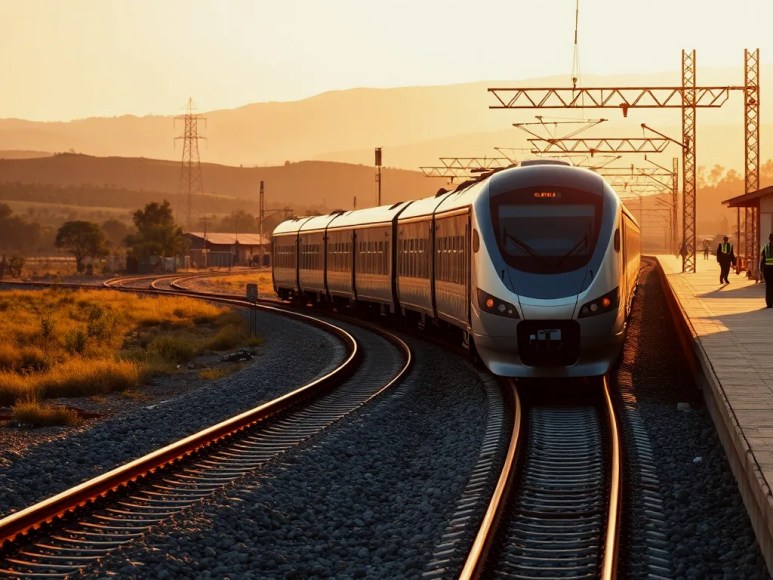
Turkish builder Yapı Merkezi has advanced the Malaba–Kampala standard-gauge railway (SGR) project to a decisive stage: after land acquisition and compensation work, Uganda has declared about 130 kilometers of the corridor ready for construction. The start of major civil works, however, awaits final financing and formal notice to proceed.
Progress in land acquisition and compensation: exact figures and what they mean
The Ministry of Works and Transport reported that out of 12,946 affected landowners, 7,721 have received compensation totaling 373.07 billion Ugandan shillings. That payment has secured roughly 2,109 acres of the 3,536 acres needed—about 60% of the required footprint—leaving unpaid claims equivalent to 472.45 billion shillings. These numbers matter because uninterrupted construction corridors reduce costly mobilization pauses and prevent expensive redesigns where parts of the right-of-way remain inaccessible.
Practical implications:
• Areas now cleared (approx. 2,109 acres) — enable continuous stretch work, particularly useful for long items such as track ballast delivery, bridge approaches and mechanized tamping.
• Remaining land and unpaid claims — will likely create patchwork construction zones unless settled; contractors typically require contiguous sections for efficient use of heavy plant and to avoid repeated demobilization.
What Yapı Merkezi has completed so far and why it matters
Under a limited notice-to-proceed issued in May 2025, Yapı Merkezi executed geotechnical investigations, topographic surveys, preliminary design, and site establishment. The preparatory program that concluded in October 2026 reduced several technical uncertainties before main works start. Key outcomes:
• Geotechnical data — allowed optimization of embankment fills, cut slopes, and foundation designs for bridges and the 2.12 km tunnel near Kampala, cutting risk contingencies for contractors and financiers.
• Site setup — created yards, access roads and temporary workshops so that when financial close arrives, construction teams can ramp to full production immediately.
On the Malaba–Mayuge section, land acquisition reached 98%, forming an almost unbroken corridor. That section is ideal for early main-line tracklaying and heavy earthworks, maximizing productivity and lowering unit costs compared to segmented worksites.
Approved financing and remaining funding path
The Islamic Development Bank approved €650.75 million in June 2026, earmarked for major infrastructure components including the 553‑metre Nile bridge, the 2.12‑kilometre tunnel, six stations and maintenance facilities. The project’s total contract value approaches €2.7 billion; the government expects to finalize the remaining funding arrangements by January 2027.
How funding status affects the schedule:
• With full financial close — contractors receive formal notice to proceed, procurement and long-lead items (steel, signaling equipment, bridge bearings) are released, and civil works accelerate.
• Without full close — preparatory works continue but major mobilization stalls; inflation, currency movements and supply‑chain disruption can increase the final cost and extend delivery timelines.
Technical highlights that will define construction complexity
Key engineering elements raise the project’s complexity profile and determine resource allocation:
• Nile bridge (553 m) — requires deep foundations and coordinated river works; Sequencing must protect river ecology and navigation.
• Kampala tunnel (2.12 km) — tunnel boring or drill-and-blast choices depend on rock type from geotechnical logs; ventilation, drainage and emergency egress design are critical and influence cost significantly.
• Stations and maintenance depot — integrated facilities must match operational plans for passenger and freight flows; early design choices affect operational efficiency for decades.
How this railway reshapes regional logistics: direct links and economic effects
Malaba–Kampala SGR aims to link Uganda to Kenya’s rail network and to Mombasa port, shifting freight from road to rail. Expected practical improvements:
• Reduced truck volumes on highways — lowers road maintenance costs, accident exposure and door-to-door transport times for bulk and containerized cargo.
• Faster throughput to Mombasa — container dwell times fall when rail frequency and reliability increase; exporters of agricultural produce and manufactured goods gain lower logistics cost and faster market access.
• Regional integration — connecting to the Kisumu–Malaba route and Kenya’s network strengthens the East African trade corridor and supports modal shift strategies by both governments.
Remaining risks and the practical steps to unlock main construction
Even with 130 km of corridor ready, three categories determine the near-term trajectory: finance, residual land claims, and procurement readiness. Actionable steps to transition to full construction:
1) Complete financial close — finalize grants/loans and contingent funding to cover the remaining funding gap; secure currency hedges for import-heavy items.
2) Accelerate compensation and dispute resolution — deploy mobile claims teams, use clear valuation templates and time-bound arbitration to clear the remaining unpaid claims.
3) Release long-lead orders — once finance is secured, issue purchase orders for signaling systems, rails, and structural steel to avoid multi-month delays.
4) Phased construction plan — sequence works so that the 98%‑cleared Malaba–Mayuge section receives tracklaying first, while complex elements (bridge and tunnel) proceed on parallel critical paths.
What to watch next: milestones and likely timeline drivers
Short-to-mid term milestones that market participants and stakeholders should monitor:
• January 2027: targeted date for completing remaining finance arrangements — if met, expect notice to proceed and contract acceleration.
• Final compensation tranche payments — resolving outstanding claims removes the major non-technical holdback.
• Procurement releases for long-lead items — will indicate readiness to start major civil, mechanical, and electrical works.
Realistically, the project’s in‑service date will remain contingent on how quickly these milestones converge; slippage in any area extends the construction window.
Concrete examples from comparable projects
Comparable SGR and main-line projects show how these dynamics play out:
• Corridor sequencing — in many African rail projects, prioritizing long contiguous sections for early tracklaying typically reduced unit installation costs by 10–20% compared with scattered short sections.
• Tunnel delivery — where geotechnical investigations were completed before main works, tunnelling risks (cost and schedule overruns) fell markedly because contractor bids carried smaller contingency premiums.
Applying these lessons, Uganda and Yapı Merkezi can contain costs by locking finance, completing land settlements quickly, and prioritizing long contiguous construction zones.
Summary: Preparatory works have pushed the Malaba–Kampala SGR to a stage where 130 km of corridor is ready and technical uncertainties have been reduced. The pathway to physical mobilization for major civil works depends on closing outstanding finance, finalizing compensation for remaining landowners, and issuing long‑lead procurement orders. If those steps align on the government’s target schedule, the project can move from preparation to full construction within months; if not, timeline and costs will expand.