
Deep Secrets of Gunung Padang: Indonesia’s Ancient Wonder
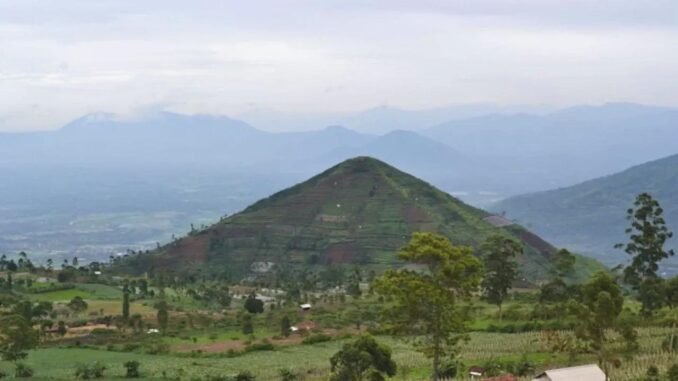
Perched on the slopes of a dormant volcano in Indonesia, Gunung Padang stands as a mysterious testament to human history’s complexity. For decades, this site has intrigued both local communities and global explorers with its complex terraces, massive stone formations, and the whispers of a mysterious past. With its unique geological and archaeological features, Gunung Padang challenges conventional timelines and suggests the possibility of an advanced prehistoric civilization that predates known cultures by tens of thousands of years.
Imagine walking up a site that looks like a natural terraced hill but reveals evidence of deliberate human modification. The structure’s arrangement of stones, some weighing hundreds of kilograms, appears to be meticulously designed rather than naturally placed. Scientific investigations over the years reveal that this site is not an ordinary geological formation. Instead, it hints at an extraordinary story of ancient engineering, possibly dating back to the late Pleistocene era, over 27,000 years ago, making it one of the oldest known megalithic sites globally.
The Geology and Structure of Gunung Padang
Gunung Padang is located in West Java and consists of multiple terraces stacked on top of each other. These terraces are constructed from large basalt stones, which have been carefully arranged to form a series of platforms. Geological studies suggest that the site originated from a volcano, and the stones were likely sourced from the volcanic rock that characterizes the region. The precise nature of this arrangement raises questions about whether the stones were placed naturally or by deliberate human effort.
Recent surveys utilizing advanced imaging technology have revealed that beneath the surface, there are additional chambers and tunnels that could be natural caves or artificially carved passages. This discovery fuels speculations that the site was not just a ceremonial or religious site but an ancient complex possibly used for navigation, astronomy, or ritualistic purposes.
Possible Ancient Origins and Dating Evidence
Estimates based on sediment samples, soil stratification, and radiometric dating suggest that some of the stones and layers could date back over 27,000 years. If confirmed, this would place Gunung Padang in the same league as some of the world’s oldest megalithic sites like Göbekli Tepe and the Australian Aboriginal ceremonial sites.
This timeline radically shifts the understanding of human civilization, implying that sophisticated engineering and cultural activities flourished far earlier than previously believed. Some researchers argue that the site could even predate the Ice Age, connecting it to early human migration theories and the development of complex societies long before the dawn of agriculture.
Controversies and Skepticism in Mainstream Archeology
The extraordinary claims about Gunung Padang have not escaped skepticism. Many professional archaeologists dismiss the site as a natural geological formation, pointing to the lack of definitive dating and clear-cut evidence of human craftsmanship. Critics argue that the stones could have been shaped through natural processes such as volcanic activity, tectonic movements, or erosion, which may produce formations that look artificial but are entirely natural.
Moreover, the absence of artifacts such as tools, pottery, or fossilized remains compels some scholars to question whether the site truly holds the ancient origin claims. They suggest that more rigorous excavations, comprehensive dating methods, and archaeological context are necessary to validate these hypotheses.
Ancient Mysteries and Modern Investigations
Despite the skepticism, ongoing research continues with some promising results. Geophysical imaging, including ground-penetrating radar and 3D mapping, indicates that there are hidden chambers and corridors beneath the surface. These findings imply a built structure rather than a natural formation, though the interpretation remains controversial.
In recent years, several international teams have become involved, aiming to analyze the site’s composition, structural patterns, and possible human activity. These investigations aim to uncover a timeline, purpose, and cultural context for Gunung Padang, potentially rewriting parts of human history.
The Cultural Significance and Popular Culture
Today, Gunung Padang has gained popularity beyond academic circles. It features prominently in documentaries, conspiracy theories, and alternative archaeology. Some enthusiasts claim the site links to lost civilizations, ancient aliens, or advanced prehistoric technology.
Local communities revere the site as a sacred place, believing that it holds spiritual power and ancestral energy. The Indonesian government and international organizations have begun to recognize its importance, gradually promoting preservation and scientific study, though debates about its origins continue.
In the broader context, Gunung Padang challenges mainstream narratives on human progress, pushing us to reconsider the timelines of civilization, technological development, and the cultural capabilities of early humans. As research progresses, this site could emerge as a crucial piece in understanding our ancient past, or simply stand as a natural wonder that was shaped by eons of geological forces.








Be the first to comment