
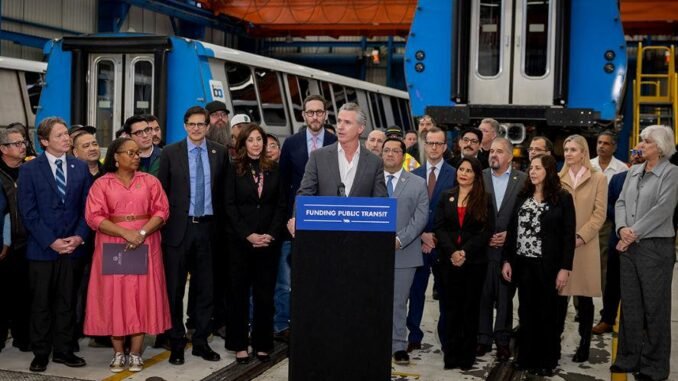
California’s transportation agencies face a looming crisis as budget deficits threaten to halt essential services across the Bay Area. In a decisive move, Governor Gavin Newsom has signed into law a groundbreaking legislation that injects $590 million in emergency funds to stabilize the region’s extensive public transit network. This financial intervention aims to stave off service interruptions and ensure millions of daily commuters continue their journeys without disruption.
The legislation, known as AB 117, represents a concerted effort by state officials to bolster the Bay Area’s transit systems during a period of fiscal uncertainty. With over 3 million riders relying on an interconnected web of ferries, trains, buses, and subways, any budget shortfall would have immediate and far-reaching consequences. The infusion of funds is designed to provide temporary relief, giving regional agencies a vital window to develop sustainable long-term solutions.
Managed by the Metropolitan Transportation Commission
The Metropolitan Transportation Commission (MTC) will oversee the disbursement and management of these emergency funds. Rather than a straightforward bailout, these loans serve as a bridge, allowing transit providers to operate smoothly while working towards more permanent financial stability. An important aspect of this support is its structured repayment plan, structured over 12 years through quarterly installments, balancing fiscal responsibility with immediate needs.
Targeted Impact on Major Transit Operators
The funds primarily benefit key transit operators within the bay area. Among them, BART (Bay Area Rapid Transit) stands to gain, with the agency facing a $376 million deficit projected by 2027. This shortfall risks provoking service cuts or even station shutdowns if not addressed promptly. The emergency financing will help keep crucial lines open, preventing the kind of disruptions that could lead to gridlock in one of California’s busiest regions.
Similarly, Caltrain—the commuter rail connecting San Francisco to San Jose—will use part of the emergency funds to maintain its recent momentum. After electrification upgrades, Caltrain experienced a surge in ridership, highlighting its importance as a sustainable alternative to car travel. Ensuring its operational continuity remains vital, especially with ongoing infrastructure improvements that necessitate reliable funding streams.
San Francisco’s Muni system serves the city’s dense neighborhoods and downtown core, also benefits from this financial lifeline. It aims to prevent fare hikes or route reductions, which could disproportionately affect local residents relying on affordable daily transit options.
The Political and Economic Context
This emergency loan is not merely a band-aid but part of a broader strategic plan. The region faces a projected $800 million budget shortfall next year. To address this, local authorities are preparing to propose a sales tax increase, slated for voter approval come November. This measure would raise approximately 1 cent per dollar in San Francisco and about half a cent in Alameda, Contra Costa, San Mateo, and Santa Clara counties. The goal is to secure sustainable revenue streams that ensure transit agencies can meet their future obligations without resorting to service cuts.
Political leaders and transit officials acknowledge that while the $590 million loan provides immediate relief, long-term solutions depend on residents and voters approving new funding measures. The region’s economic recovery, especially from the pandemic’s aftermath, hinges on maintaining efficient, extensive transit options that support growth and reduce congestion.
Operational and Strategic Challenges
Transit agencies have been grappling with financial strain, exacerbated by declining ridership during COVID-19 and rising operational costs. The financial support from the state aims to stabilize daily operations, but it also underlines the critical need for resilience planning. Agencies are exploring innovative strategies, including technology upgrades and fare policy adjustments, to optimize revenue and reduce costs.
Leadership within these organizations emphasizes that emergency funding alone cannot solve systemic issues. Instead, it buys the much-needed time to implement structural reforms, prioritize investments in sustainable infrastructure, and align future service expansion with available resources.
Broader Implications for Regional Mobility
Investing in transit stability has ripple effects beyond immediate service concerns. Reliable public transit encourages wider adoption of environmentally friendly transportation, reduces traffic congestion, and enhances access for underserved communities. Ensuring that these systems operate smoothly strengthens the region’s economic vibrancy and social equity.
Furthermore, this financial support sets a precedent for how governments can proactively respond to infrastructure crises, combining emergency aid with strategic planning for long-term success. The collaboration among local governments, transit operators, and the state exemplifies a holistic approach to regional mobility challenges.
As the Bay Area nears a pivotal moment, the collective efforts to fund, manage, and reform transit services will shape its development for decades to come. The $590 million loan is a critical step, but future stability depends on sustained political will, community support, and innovative financial strategies.








Be the first to comment