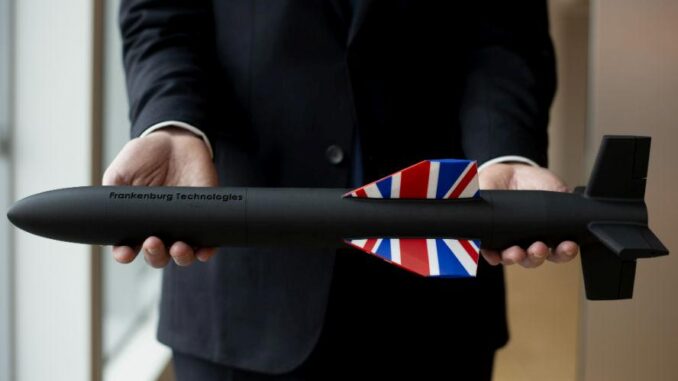
A revolutionary step is being taken in maritime security with a survival-oriented defense innovation. Babcock and Estonian startup Frankenburg Technologies have joined forces to develop a low-cost, rapidly manufacturable and scalable missile launch platform against unilateral attack drones. This partnership offers a model that integrates local capabilities into the global security chain, and research and development activities led by UK technology aim to increase sovereignty and security capacity. The results create a new standard in the industry, especially when it comes to economical production rates and high-volume defense solutions.
In this project, the design and production process of the Mark 1 missile is launched as the world’s smallest guided missile, approximately 60 centimeters long. This process, which was initiated by Estonia in October, aims to establish production facilities within the Defense Industrial Park and strengthen local production capacity. In the first phase, the daily production of 100 short-range air defense missiles is planned; This stands out as a number that will directly contribute to operational mobility in the field.
Missile technology and production capacity
Frankenburg CEO Kusti Salm points out that the company’s 60 cm long Mark 1 missile is the world’s smallest guided missile. The company adopts Estonia’s goal of strengthening local industrial capacity through the election process and focuses on a production capacity of approximately 100 units per day. This stands out as the result of a design supported by commercial components with high operational flexibility. The fact that the missiles use solid-fuel rocket engines and utilize a high percentage of commercial components reduces production costs and reduces vulnerabilities in the supply chain. Technically, the success of reaching the live firing test from concept stage to live firing test in just 13 months clearly demonstrates the scalability of the processes. The tests carried out at the NATO base in Latvia in December provide complete success against moving targets, signaling a SpaceX-like improvement in the industrial field.
Strategic collaborations and future vision
CEO Kusti Salm states that the partnership will increase global export opportunities and provide new, cost-effective and scalable solutions for the protection of military personnel and critical infrastructures across Europe. He emphasizes that Frankenburg’s Mark 1 missile meets the criteria of low cost and rapid response, especially in combating UAV threats. In this context, the two companies are signing projects for missile integration into Poland’s PGZ platforms in November and plan to increase local production capacity with a target of producing approximately 10,000 missiles annually. Thus, the goal of producing economical solutions against unmanned aerial vehicles on the battlefield becomes a critical turning point for the defense industry.
Operational impacts and contributions to the security ecosystem
This type of partnership not only increases the production of missiles; It also supports a holistic security approach to protect critical infrastructures by bringing together capabilities from the defense industry ecosystem. Frankenburg’s modular manufacturing approach strengthens local industrial capacity by enabling small-scale, fast-cycle production processes. This provides integrated solutions to meet the threats encountered in the field of sea defense and air defense. In addition, the goal of reducing costs through high-speed production makes it possible to respond more quickly to the dynamic needs of defense budgets.
Technological depth: Design philosophy of missiles
The Mark 1 missile family, powered by solid-fuel rocket engines, highlights a design focused on compact dimensions and high accuracy. Innovations in power transmission and thrust management are optimized to deliver high-level performance with low-cost components. The missiles’ guidance system and rapid response capabilities establish effective defense lines against UAV threats. Completing the test fire stages in production facilities in a short time proves the rapid transition of research and development processes to industrial scale. In addition, the successes of the tests carried out in Latvia support investments in coordinated international security infrastructures.
Future steps and global impact
The cooperation offers a roadmap centered around the missile integration project on Polish PGZ platforms. This step enables the integration of local production with the global supply chain, increasing competitiveness in the international defense market. The annual production capacity target of 10,000 missiles stands out as a turning point in terms of stock management, logistics and supply chain efficiencies. These results serve as a guide for security architects looking for low-cost and responsive solutions. Babcock and Frankenburg aim to support the objectives of protecting defense personnel and critical infrastructures across Europe by elevating local capabilities to global security standards in the process. In addition, integrating sea defense solutions into modular architectures makes it easier to create integral defense lines against different sea and air threats.
In the following stages, detailed performance indicators (KPIs) will be closely monitored for feasibility, cost balance and sustainability of local production capacity. While this will expand the defense industry’s innovative product portfolio, it will be noted as an exemplary model in international cooperation.