
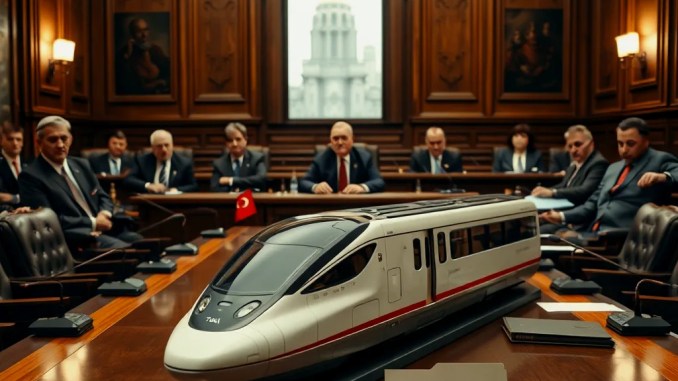
Overview of TÜRASAŞ’s 2023–2024 Activity and Strategic Focus
TÜRASAŞ presented its 2023 and 2024 activity and financial results to the Turkish Grand National Assembly’s State Economic Enterprises (KIT) Commission. The session included ministry representatives and focused on accelerating domestic rail vehicle production, reducing import dependence and scaling engineering and manufacturing capabilities for the national rail industry.
Current Status of National Train and Locomotive Projects
TÜRASAŞ reported concrete progress on three flagship programs: the National (National) Electric Train, the National High-Speed Train, and the E5000 Milli Electric Locomotive. The company outlined delivered milestones, near-term production targets and key technical achievements such as modular vehicle architectures, locally sourced traction systems and in-house bogie designs. Data presented showed prototype testing phases completed for several subsystems and planned serial production ramp-ups tied to factory capacity upgrades.
How TÜRASAŞ Is Reducing Import Dependence
TÜRASAŞ is replacing critical imported components with domestic alternatives in a staged approach: first by reverse-engineering select parts and validating performance; second by partnering with local suppliers for tooling and materials; third by qualifying suppliers through joint testing programs. Example: traction inverters that were previously imported underwent a 12-month development cycle with a Turkish electronics firm, resulting in a tested unit that meets the same thermal and electrical load profiles at a higher local content percentage.
Role of Sivas, Sakarya and Eskişehir Facilities
Sivas, Sakarya and Eskişehir facilities each specialize in complementary production stages that form a national manufacturing chain. Sivas focuses on heavy structures, freight wagons and bogie assemblies; Sakarya emphasizes electrical systems integration and vehicle final assembly; Eskişehir concentrates on R&D, prototyping and testing infrastructure. Coordinating workflows among these plants have reduced lead times, enabled parallel workstreams and optimized utilization of specialist equipment.
Examples of Production Workflow and Capacity Increases
Production workflow steps now practiced across plants:
1. Design handoff and modularization: Engineering teams deliver modular subsystem packages so multiple plants can work in parallel.
2. Subassembly fabrication: Sivas and Eskişehir produce heavy mechanical components while Sakarya fabricates electrical cabinets and integrates traction systems.
3. System integration and testing: Final assembly in Sakarya, followed by static and dynamic testing; telematics and software verification occurs in Eskişehir.
Capacity increases include expanded welding lines, additional test rigs for bogies and a second dynamics test bench. These investments shorten cycle times and increase annual throughput projections by measurable percentages presented to the commission.
Engineering, Workforce and Skill-Building Initiatives
TÜRASAŞ highlighted targeted investments in engineering staff and vocational training: structured apprenticeships in mechanical assembly, dedicated courses for power electronics and partnerships with technical universities for joint R&D projects. The company quantified gains by citing reduced rework rates and faster qualification times for new suppliers after implementing these programs.
Quality Assurance, Standards and Certification Pathways
TÜRASAŞ described a layered quality assurance framework: supplier incoming inspection, subsystem acceptance tests, full-vehicle verification and certification trials with national regulators. The company pursues international interoperability standards where necessary and uses staged certification gates to move vehicles from prototype to serial production without compromising safety or reliability.
Financial and Operational Outcomes Discussed
The commission review included financial metrics tied to operational decisions: capital expenditures for capacity upgrades, projected savings from reduced imports, and revenue forecasts based on domestic and export order pipelines. Presentations linked investments to expected payback periods and to employment multipliers in the regional economies around the three plants.
Immediate Targets and Roadmap to Scale
Short-term targets presented to the commission included completing serial production validation for at least one national train model, increasing local content thresholds for traction and control subsystems, and finalizing supplier qualification for critical mechanical parts. Mid-term goals emphasized export readiness and achieving steady-state production that supports both domestic replacement programs and international sales.
Impacts on Regional Industry and Employment
Officials emphasized how upgraded facilities and higher production rates increase regional industrial demand for sheet metal work, precision machining and electronics assembly. The Sivas facility, for instance, was highlighted for generating skilled jobs linked to wagon manufacturing and bogie systems, supporting local supply chains and vocational employment pathways.
Key Takeaways and Next Steps
TÜRASAŞ’s update provided the commission with a clear picture of technical progress, factory-level changes and workforce development measures supporting a strategy to localize rail vehicle production. Next steps include phased serial production approval, deeper supplier development programs and continued transparency with regulators and parliamentary oversight bodies to align program timelines and funding.



Be the first to comment