
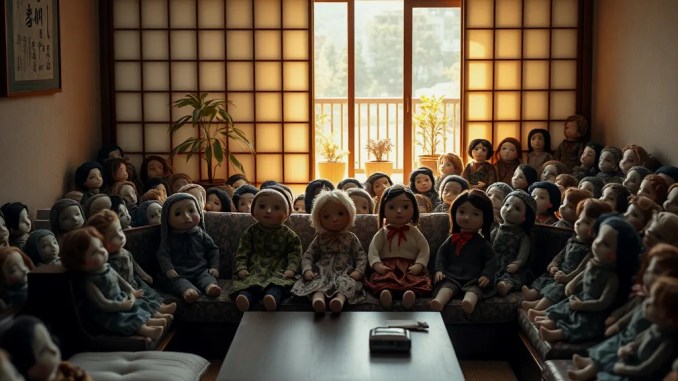
Nagoro, a remote village on Japan’s Tokushima Island, transformed from near-abandonment into a striking open-air installation when artist Ayano Tsukimi began making life-size rag dolls that stand in place of missing residents. Using simple materials and careful observation, she reconstructed scenes of daily life—schoolrooms, bus stops, fields—so that the village itself now functions as both memorial and social portrait.
How Ayano Tsukimi Recreated People and Scenes with Rag Dolls
Tsukimi returned to her childhood village to find many houses empty and streets silent. She collected straw, fabric scraps and discarded clothing and sculpted human-scale dolls whose faces, clothes and postures echo real villagers she remembered. She matches hair, posture and clothing to specific individuals—deceased neighbors, emigrants and typical villagers—so each figure carries a recognisable identity. The process is deliberate: choose a subject, select clothing from local donations, stuff and shape the body, and set facial features to reflect age and expression. That sequence produces figures that read at a glance as people, not props.
Where the Dolls Are Placed and What Each Scene Communicates
Tsukimi installs dolls in situ to recreate everyday activities and the village’s rhythm. Examples include:
Schoolroom scenes: Desks lined with doll-students and a teacher at the blackboard recall a closed school’s former life and provide a clear visual answer to the question “What happened to the school?”
Bus stop figures: Dolls placed on benches simulate waiting passengers and indicate past mobility patterns—who left and when.
Field workers: Straw-hatted figures placed amid crops hold hoes and sickles, showing agricultural labor that sustained the community.
These placements function as data points for observers: they reveal family roles, population segments most affected by out-migration, and the seasonal cycle of rural labor.
Why Nagoro’s Installation Attracts Visitors and Researchers
Nagoro draws tourists, photographers and academics for several measurable reasons. First, the visual contrast—dozens of fixed figures against a near-empty population—creates strong photographic compositions and a memorable visitor experience. Second, the site provides a compact case study of rural depopulation: number and distribution of dolls map directly onto demographics (age cohorts and occupations) that scholars use to illustrate migration trends. Third, the village’s authenticity—materials sourced locally, figures modeled on real people—gives researchers ethnographic detail they can cite in studies about memory, loss and place-making.
What the Dolls Reveal about Demographics and Rural Decline
Counting and categorizing the dolls produces clear insights. For example, the predominance of elderly figures highlights the age structure left behind after young adults move to cities. The presence of more domestic and agricultural figures than industrial or service workers shows the village’s economic base. By mapping the dolls’ locations and attributes, one can reconstruct a socio-economic snapshot: households that remained, whose livelihoods persisted, and which social roles disappeared first.
Practical Steps to Create a Community Memory Project like Nagoro’s
Communities that want to adopt a similar approach can follow a practical sequence:
1. Document the living memory: Interview elders and collect photographs to guide accurate representation.
2. Source materials locally: Use donated clothes and agricultural materials to root figures in place.
3. Prioritise key locations: Start with sites of strong symbolic value (school, market, bus stop).
4. Involve residents: Invite volunteers to help build figures and choose placements to ensure buy-in and authenticity.
5. Maintain and rotate: Plan for seasonal repairs and occasional repositioning to keep the installation legible and relevant.
Common Questions Visitors Ask and Clear Answers
Are the dolls meant to replace people? No. They function as memorials and visual cues about who used to live and work in the village.
Who maintains the dolls? The artist and a handful of local volunteers perform repairs and replacements when materials degrade.
Is the project an artwork or a civic effort? It is both: an art installation in form and a community-led memorial in function.
Lessons Nagoro Offers to Other Rural Communities
Nagoro demonstrates that low-cost, locally anchored interventions can generate attention, preserve memory and catalyse small-scale cultural tourism. The village shows how material culture—clothing, posture, placement—can communicate demographic change more immediately than statistics, making the abstract visible and prompting visitors and policymakers to ask targeted questions about rural viability.
Visitors who engage respectfully and researchers who combine the visual record with demographic data can draw richer, actionable conclusions about the causes and consequences of rural depopulation.






Be the first to comment