
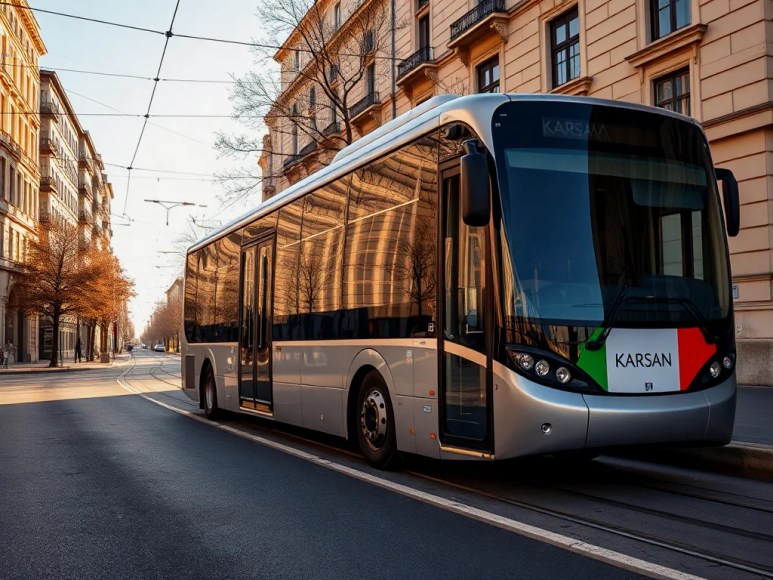
Bologna contract and order details
Karsan secured a contract with TPER in Bologna through its Italian dealer KMOBILITY, agreeing to deliver 35 new 18-metre e-ATA trolleybuses with an option to expand to 70 vehicles. The order follows a prior delivery of 24 18-metre e-ATA electric buses and will raise Karsan’s fleet in Bologna to 59 vehicles if all options are exercised. The agreement includes maintenance, spare parts and technical support packages to ensure continuous operation and quick vehicle turnaround during service peaks.
How the e-ATA trolleybus operates on and off the catenary
The e-ATA combines traditional trolleybus overhead power with onboard batteries that charge while cruising under the catenary. When the vehicle moves onto sections without overhead lines, it seamlessly switches to battery power. This dual-mode operation reduces the need to install continuous overhead wiring, shortens project lead-times for route extensions, and lowers infrastructure costs.
Key technical specifications and performance metrics
The Bologna-configured e-ATA features four doors, a low-floor layout and seating optimized for rapid passenger flow. It supports up to 146 passengers, delivers up to 22,000 Nm peak torque and accepts external DC charging up to 200 kW. Climate systems, accessible passenger zones and advanced driver assistance systems (ADAS) complete the equipment list. These metrics translate to strong hill-climb performance, quick recharge cycles at depots and flexibility for mixed catenary/battery route profiles.
Benefits for operators and urban planners
Operators gain operational flexibility: routes that currently require continuous overhead wiring can be run partially or temporarily without it, reducing capital expenditure and visual impact. Planners can pilot route changes or extensions using battery-mode segments to assess demand before committing to infrastructure. Maintenance contracts bundled with the purchase reduce downtime and provide predictable lifecycle costs.
Real-world examples and expected operational scenarios
In Bologna, Karsan’s previously delivered 24 e-ATA vehicles demonstrated smoother boarding times thanks to the four-door, low-floor design and improved energy efficiency on frequent-stop urban lines. A typical scenario: a vehicle charges under the catenary on a central artery, then detaches to serve a newly pedestrianized neighborhood using battery power for several kilometers before reattaching on the return. That pattern minimizes street-level overhead wiring in historic areas while maintaining service frequency.
Maintenance, support and total cost of ownership considerations
Including maintenance and spare parts in the contract shifts short-term risk to the manufacturer and enables predictable budgeting for transit agencies. Key TCO elements operators should track: battery replacement intervals and costs, inverter and traction motor warranties, depot DC-charging infrastructure utilization, and ADAS software update cycles. Proactive analytics from telematics can extend component life by optimizing charge/discharge cycles and regenerative braking profiles.
Passenger experience and accessibility
Design choices prioritize accessibility and comfort: continuous low floor, dedicated spaces for wheelchairs and strollers, climate control tuned for Mediterranean summers and insulation for off-season use. Higher passenger capacity and four-door layouts reduce dwell times at busy stops, improving timetable adherence and perceived reliability.
Implementation steps for transit agencies
Step 1: Map routes to identify which segments require catenary and which can run on battery; Prioritize historic or visually sensitive corridors for battery-mode operation.
Step 2: Define depot charging strategy—opportunistic charging under catenary, overnight depot charging, or mid-day high-power DC top-ups—and size on-site chargers accordingly (up to 200 kW per vehicle when needed).
Step 3: Negotiate maintenance and spare parts packages with clear KPIs for vehicle availability, mean time to repair and battery health targets.
Step 4: Implement telematics to monitor energy usage, regenerative braking recovery and component wear; use data to refine schedules and charging profiles.
What to watch for when deploying mixed catenary/battery fleets
Operators should monitor harmonization of charging standards, peak depot power demand and the interplay between battery aging and route assignments. Over-assignment of heavy routes to older batteries will accelerate degradation; rotate vehicles and adjust charging regimens to maintain consistent fleet capability. Ensure compatible DC charging interfaces and plan for spare battery inventories if uninterrupted service is critical.
Projected outcomes for Bologna
Karsan’s delivery of 35 additional e-ATA trolleybuses is likely to improve service resilience, reduce visual clutter on selectively battery-operated streets and offer Bologna a pathway to expand electric mass transit without full catenary coverage. If the optional order is exercised, the city will further consolidate an electric fleet that balances infrastructure cost with operational flexibility.