
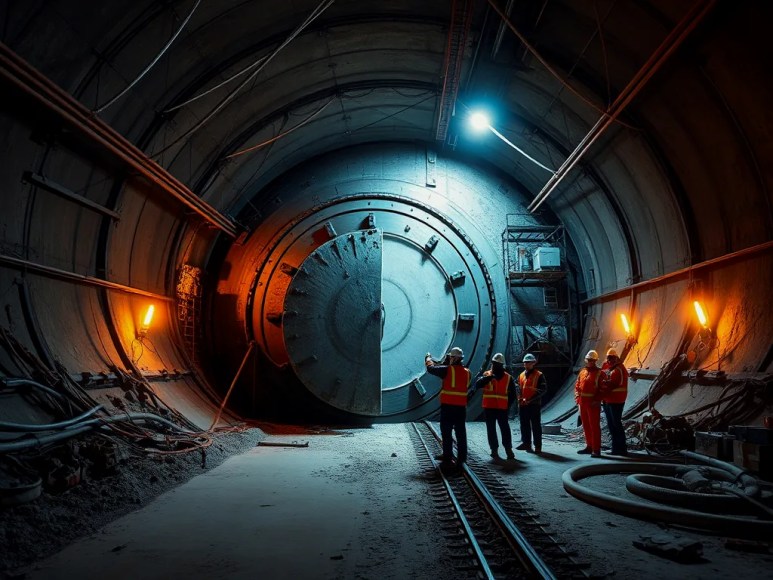
Two tunnel boring machines (TBMs) named Madeleine and Karen have passed the halfway mark on the roughly 7.2 km Old Oak Common–Euston tunnel drive for the HS2 high-speed rail project in London.
An average progress of 16 meters per day
Progress and schedule: Madeleine began tunnelling on 27 January 2026 and Karen on 16 March 2026. Together, the twin TBMs — each weighing 1,624 tons — have averaged about 16 meters of forward progress per day, reaching the section between West Hampstead and Kilburn High Road by 17 November. The contractor consortium Skanska, Costain and STRABAG operates the continuous 24/7 excavation campaign, sequencing drives, segment assembly, and spoil removal to sustain that pace.
Operational detail: Maintaining a 16 m/day average requires tight coordination: TBM face maintenance every shift, pre-cast concrete segment deliveries timed to ring construction, ventilation and dust control, and immediate spoil transfer to rail-loading points. This reduces downtime from cutterhead maintenance and ring erection.
HS2’s deepest twin tunnel and excavation volumes
Depth and materials: The two Euston bores extend up to 50 meters below ground. Excavation will generate roughly 1.5 million tonnes of material. Contractors will line the tunnel with 48,294 precast concrete segments fabricated in Hartlepool; each segment set forms watertight rings that provide long-term structural support.
Examples of logistics: For comparison, a single TBM ring uses multiple bespoke segments; at the current production and installation rate the segment factory must average targeting, transport and quality control of hundreds of segments weekly. The Hartlepool facility’s throughput and sequencing are therefore central to avoiding on-site backlog.
Tunnel drives already completed on the wider HS2 route
Completed drives and lengths: HS2 has finished several major twin-tunnel drives: Chiltern (16 km), Northolt (13.6 km), Bromford (5.6 km) and Long Itchington Wood (1.6 km). The Old Oak Common–Birmingham corridor’s roughly 37 km of twin tunnels are complete apart from the Euston approach, making Euston the last deep twin-tunnel section remaining in active excavation.
Relevance: Completing the Euston drives will unlock downstream fit-out works: drainage, trackbeds, utilities and systems installation, allowing testing and progressive commissioning toward service readiness.
TBM dismantling and decommissioning plan in 2027
Extraction strategy: Project teams plan to stop the TBMs underground near Euston in 2027. Major components will be hauled back along the tunnel for extraction where feasible. The 8.53 m diameter cutterheads will be lifted from a specially prepared excavation area at Euston. The steel outer shields, however, are scheduled to remain inside, positioned behind the concrete lining and grouted into place to act as buried permanent structures where removal would be disruptive and costly.
Step-by-step dismantling: 1) Secure TBM and stabilized surrounding linings. 2) Strip external services and detach cutterhead. 3) Transport main drive shell components to the extraction shaft. 4) Lift cutterhead units through the surface opening at the Euston removal zone. 5) Grout and seal leftover shield interfaces to integrate with permanent lining.
Projected completion dates and service entry windows
Timeframes: HS2 Ltd lists a target finish for the Euston tunnelling works of 30 June 2027. National-level rephasing announced by the UK Department for Transport on 19 May 2026 anticipates first services on the Old Oak Common–Birmingham Curzon Street corridor between 2036 and 2039. Full scheme delivery, including the London Euston connection, is estimated in a 2040–2043 window. Updated capital cost ranges stand at £87.7–£102.7 billion.
Context and caveats: These dates represent current planning assumptions used for procurement, commissioning and long-lead systems procurement. Phased commissioning and local trial operations typically follow tunneling completion and can compress or lengthen the eventual passenger-opening timeline depending on systems integration outcomes.
Euston station redevelopment and new delivery model
Delivery company and scope: A newly formed Euston Delivery Company will lead redevelopment: building the HS2 terminal, remodeling the existing station, implementing London Underground enhancements and enabling commercial development around the transport hub. The Department for Transport has begun pre-procurement talks with private sector partners able to undertake design, build, finance and long-term maintenance responsibilities, aiming to attract integrated bids that align station operations with urban regeneration objectives.
Commercial example: Integrated delivery might bundle station concourse, retail leases and long-term facilities management into a single concession structure to drive private capital toward upfront cost and operational efficiency while transferring certain performance risks away from the public sector.
Spoil movement by rail to cut road haulage
Planned logistics: Mace Dragados will excavate down to around seven meters at the Euston station box. HS2 Ltd intends to move up to 170,000 tonnes of spoil from that site by rail rather than road. GB Railfreight will run two daily freight services, each carrying roughly 715 tons, which aims to eliminate the equivalent of more than 10,000 heavy truck trips on local roads during the works.
Operational benefits and numbers: Using two ~715 t trains per day equates to around 1,430 tons/day capacity; spread over the active spoil removal period this materially reduces noise, emissions and congestion. Rail logistics require matched timings for spoil delivery to railheads, dedicated loading infrastructure at the site, and contingency plans for rail network disruption.
Network benefits once Euston link opens
Capacity and service reshaping: HS2 Ltd anticipates that moving intercity services onto the new high-speed lines will relieve capacity pressure on the West Coast Main Line (WCML). Freeing up paths on the WCML can enable additional regional, commuter and freight services, improving timetable resilience and allowing operators to introduce new local patterns.
Example scenario: If two hourly intercity paths are shifted onto HS2 during peak windows, rail planners could reallocate those slots to introduce faster regional expresses or additional stopping services, potentially shortening journey times on local corridors or increasing frequency during peak demand.
Why the Euston drives matter now
Strategic value: As the final deep twin-tunnel section, completing the Euston drives clears a major construction bottleneck affecting fit-out, systems installation and station integration. The TBMs’ steady progress, coordinated segment supply, and rail-based spoil removal together reduce construction risks and community impacts while signaling a tangible shift from primary excavation to installation and testing phases across the HS2 corridor.
Key data summary: TBMs: Madeleine & Karen; TBM start dates: 27 Jan & 16 Mar 2026; Avg advance: ~16 m/day; Excavation volume: ~1.5 Mt; Tunnel lining segments: 48,294 from Hartlepool; Spoil by rail: up to 170,000 t via two daily ~715 t trains; TBM extraction: planned 2027; Tunnel works target end: 30 Jun 2027; Service windows: 2036–2039 (first Old Oak–Birmingham services), 2040–2043 (full Euston link completion); Cost estimate: £87.7–£102.7 bn.