
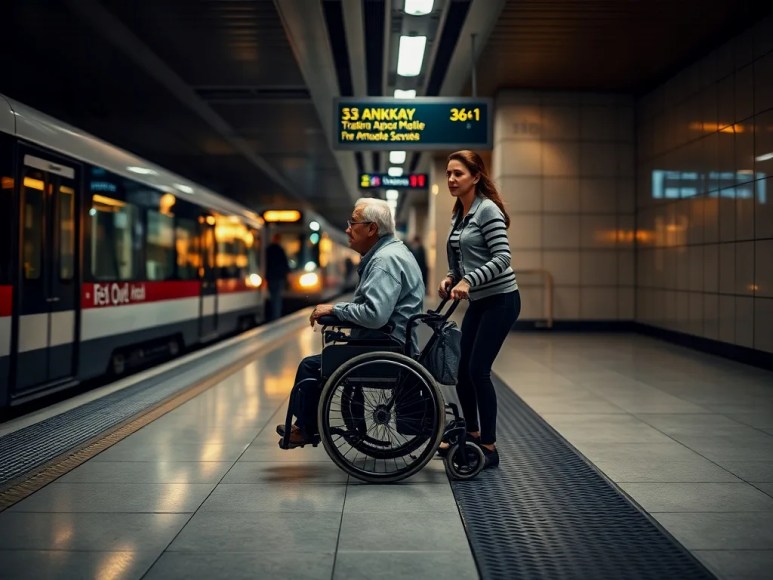
Söğütözü ANKARAY connection remains closed to train service
Background and current status: Construction of the Söğütözü ANKARAY station finished in 2008, but the station has not carried trains because of a signaling incompatibility between the ANKARAY system and the adjacent lines. The pedestrian connection opened in 2023; However, passengers traveling from AŞTİ towards Çayyolu cannot use a direct train link and must transfer at Kızılay instead. That enforced transfer adds walking and waiting time and concentrates accessibility needs at Kızılay.
Inventory of accessibility equipment across the network
System totals and what they mean: The 2024 Ankara Metropolitan Municipality activity report lists 160 elevators, 13 designated disabled platforms, and 8 moving walkways across the rail network. Those counts indicate the municipality has installed vertical and horizontal mobility aids, but they do not reveal distribution by station, operational status, or installation dates—details critical for travel planning by passengers with reduced mobility.
Why and why gaps matter: station-level issues
Platform-to-train height and gap problems: On ANKARAY, differences in vertical height and horizontal gap between platforms and carriages remain a major barrier. Some stations rely on portable ramps deployed by staff or passengers; This practice creates inconsistent boarding times and can make single-person independent boarding impossible. Where platform edge markers or tactile strips exist, they are sometimes worn or misaligned, reducing their effectiveness for visually impaired travelers.
Service interruptions and temporary closures that affect accessible routing
Planned works and route impact: The A and D exits at MTA Station are scheduled to close from 24 November to 13 December 2026 for maintenance. Those closures change the optimal accessible routes through nearby stations and raise the importance of publicly available diversion maps and real-time notices. Without updated station-level guidance, passengers who rely on specific elevators or exits can experience substantially longer or unsafe detours.
How authorities coordinate fixes and what’s missing publicly
Institutional roles and limitations: EGO General Directorate handles operation and maintenance, while the Ankara City Council Disability Assembly represents user needs and advocates upgrades. EGO reports routine maintenance activities, but it has not published a detailed, station-by-station timetable for repairs or upgrade rollouts. That lack of transparent scheduling prevents users and advocacy groups from planning alternatives or tracking progress.
Practical travel planning for passengers with reduced mobility
Step-by-step checklist before travel:
1) Identify critical stations on your route: Choose transfer points that historically report multiple elevators and staff presence (for example, Kızılay).
2) Verify live equipment status: Contact EGO customer service or check official social channels immediately prior to travel; if unavailable, assume an elevator may be out of service and prepare a backup route.
3) Account for platform-to-train gaps: If step-free boarding is required, request station staff assistance in advance or choose lines with level boarding where possible.
4) Prepare for temporary closures: Monitor scheduled works (like the MTA exit closures) and adjust departure times and transfer stations accordingly.
5) Carry lightweight portable aids: When possible and safe, small ramps or mobility-assist devices can reduce dependency on ad-hoc station solutions, while recognizing that station staff assistance remains essential for safety.
Examples and small-scale solutions that reduce disruption
Operational practices that work elsewhere: Deploying real-time elevator status feeds to a public API reduced unexpected detours in several European cities. Likewise, station-specific staff training on rapid portable ramp deployment decreased boarding times by measurable minutes in pilot programs. For Ankara, targeted pilots at major hubs (Kızılay, ANKARAY transfer points) could test these operational changes within months, not years.
What accessible-route monitoring should include
Recommended data points for public disclosure: For each station disclose: 1) number and location of elevators and their current operational state; 2) presence and condition of step-free transfer routes; 3) staff contact point and typical staffing hours; 4) dates and expected duration of planned closures; 5) Alternative accessible transfer routes with estimated additional walking time. Publishing these as machine-readable feeds enables third-party journey planners and voice-assistive apps to present reliable alternatives.
Short-term priorities and a roadmap for measurable improvement
Immediate actions (0–6 months): Publish a station-level inventory and create a simple real-time reporting channel for elevator outages.
Medium-term (6–18 months): Pilot real-time status APIs at high-traffic transfer stations, train staff in rapid-assist boarding procedures, and install permanent ramps where gap mitigations are repeatedly needed.
Long-term (18+ months): Harmonize signaling systems to open pending connections like Söğütözü for train operations, retrofit platforms for level boarding where feasible, and commit to a publicly accessible, regularly updated maintenance calendar.
How passengers and advocacy groups can push for faster change
Practical advocacy steps: Aggregate and publish ride logs showing where elevators fail and when diversions occur; submit formal requests for machine-readable outage data; propose small pilots (eg, portable ramp teams) tied to performance metrics; and negotiate fixed timelines for high-impact upgrades such as platform leveling at the busiest transfer points. Concrete data and time-bound proposals make collaboration with EGO and municipal stakeholders more actionable.