
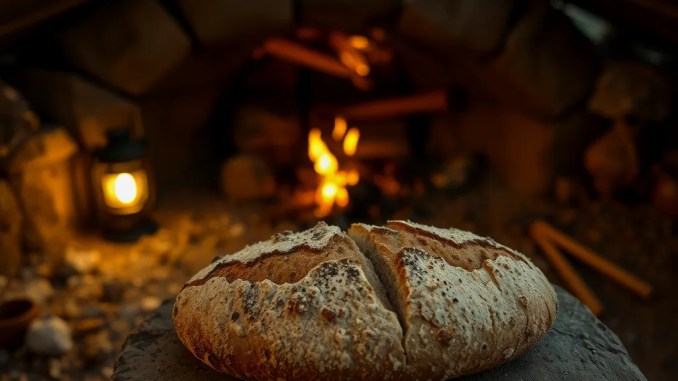
Fire Preserved Eight Bread Loaves and Stored Grains
Archaeologists recovered eight carbonized breads along with charred barley and lentil remains from a burnt storage room at Seyitömer Mound, 26 km from Kütahya city center. Excavation director Dr. Sevgi Gürdal dates the layer to the Early Bronze Age (around 3000 BCE). The team found a collapsed shelf and adjacent oven features; fire consumed the building but carbonization arrested biological decay, leaving dense, stable fragments of once-perishable foods. These preserved items provide a direct snapshot of household provisioning and food processing practices at a single moment in time.
How the Burn Event Created an Archaeological Time Capsule
When organic material burns under low-oxygen conditions it often chars rather than fully combusts. That carbon-rich residue resists microbial decomposition and preserves shape and internal structure. At Seyitömer, the sequence of collapse—shelves falling, sacks rupturing and ovens overheating—effectively sealed breads and legumes in situ. Excavators documented spatial relationships precisely: loaves lay between shelf stumps while scattered grain concentrated near sack impressions, allowing analysts to reconstruct storage methods and the probable sequence of the catastrophe.
What the Breads and Pulses Reveal About Diet and Technology
Microscopic and macrobotanical analysis of the specimens indicates a mixed cereal and pulse diet. Grain morphology points to hulled wheat varieties (likely emmer or einkorn) and lentils that match domesticated types known from contemporaneous Anatolian deposits. The breads’ shapes and surface textures suggest small, possibly flat loaves baked on hot surfaces or in simple hearth ovens—consistent with the nearby oven remains. Combined, these data indicate households stored processed foods and raw staples together, showing a degree of food planning and preparation that reduced daily labor and increased.
Methods Used to Study the Finds and Their Reliability
Researchers used a sequence of standard archaeobotanical procedures: flotation to separate carbonized plant remains from matrix, stereomicroscope assessment to identify grains and pulses, and morphometric comparison against reference collections. Radiocarbon samples from charred bread fragments and associated charcoal produced calibrated dates that align with Early Bronze Age chronologies. Where possible, residue analysis and microstructure imaging helped infer dough composition and baking temperature ranges, increasing confidence in functional interpretations.
Connections to Settlement Economy and Storage Practices
Seyitömer’s archaeological context suggests a mixed agrarian economy with structured storage systems. The presence of shelving elements and sack residues inside the demolition horizon demonstrates purposeful long-term provisioning. Local lignite deposits under the mound later motivated salvage excavations, but the preserved storage assemblage indicates households practiced bulk preparation and conservation strategies: parbaked or fully baked loaves kept for quick consumption, and pulses stored dry for seasonal use or processing.
Museum Display and Public Value of the Discoveries
The loaves, grains and associated finds are now cataloged and displayed at the Kütahya Archeology and Mining Museum. Exhibition labels present contextual photographs, stratigraphic diagrams and laboratory results so visitors can see the connection between field context and scientific interpretation. Public displays emphasize tangible daily life—foods people actually ate—rather than abstract chronology, helping audiences form immediate connections to a 5,000-year-old household.
Long-Term Research Questions and Next Steps
Ongoing research will expand isotopic and starch-wear studies to explore field management, crop origins and whether stored foods contained additives (like fat, wild plants or fermentation residues). Comparative studies with other Early Bronze Age Anatolian storage assemblages will test whether Seyitömer represents local tradition or wider dietary practices. Excavators will also integrate paleoenvironmental data to understand how climate and landscape affected crop choices and storage strategies.
Why This Discovery Matters for Understanding Everyday Life
Carbonized breads and pulses offer one of the clearest direct lines to past daily routines. They reveal not only what people ate, but how they organized labor, managed risk, and used simple technology to extend food lifespans. Rather than elite artifacts, these remains illuminate the mundane decisions—baking, stacking, stowing—that sustained communities over generations and that shaped resilience in the face of disasters like fire.






Be the first to comment