
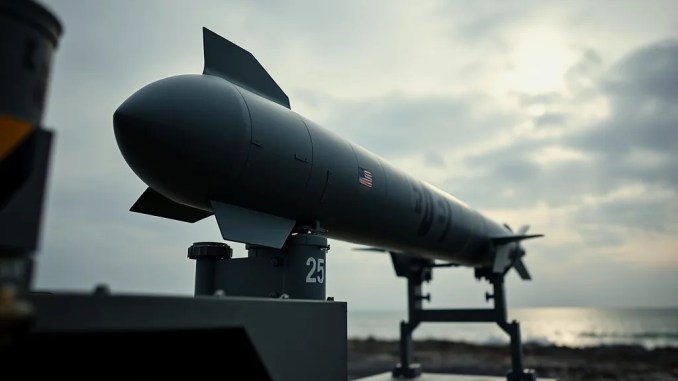
Japan publicly displayed its domestically developed Type-25 ship-to-shore guided missile, a system reported to reach approximately 1,000 kilometers, during the Keen Sword exercises on October 19. The demonstration at Onohara training area near the Nagasaki–Saga border showcased vehicle-mounted launchers oriented southwest, signaling operational focus toward nearby maritime contingencies.
Type-25 missile: what it is, range and deployment plans
The Type-25 (25SSM) is a road-mobile, vehicle-launched anti-ship/ship-to-shore guided weapon designed for rapid emplacement and shoot-and-scoot operations. Japanese Defense sources report an approximate maximum range near 1,000 km, which places several coastal areas across the East China Sea within reach. Japan plans staged deployment of these home-produced missiles to positions in Shizuoka Prefecture by fiscal 2027 to bolster southern coastal deterrence.
How the missile was demonstrated and the tactical setup
Personnel from the Japan Self-Defense Forces prepared and displayed full launch procedures at the Onohara range. The demonstration emphasized:
Vehicle-mounted launcher emplacement: crews oriented launchers southwest to simulate engagement profiles toward key maritime corridors.
Rapid readiness drills: teams practiced preparing the system for firing from highway-transportable platforms, highlighting mobility and reduced setup time.
Firing procedures review: operators ran through command-to-launch checklists and safety corridors, underlining interoperability with ground control and reconnaissance inputs.
Why Japan emphasizes these capabilities now
Senior GSDF leadership framed the Type-25’s addition as strengthening Japan’s ability to deny adversary access and project credible deterrence at extended ranges. The public display serves multiple purposes: validating system readiness, signaling intent to potential challengers, and informing allied partners of Japan’s evolving force posture.
Keen Sword 2023: scope, participants and mission focus
The Keen Sword exercise (19–29 October) spans 33 prefectures and integrates land, sea, air, space and elements cyber. Approximately 57,000 personnel participate—45,000 from Japan and 12,000 from the United States—conducting combined maneuvers that test joint command-and-control, distributed fires, anti-ship/air defense coordination, and logistics under contested conditions.
Operational implications for regional security and force employment
Deploying a ~1,000 km ship-to-shore missile changes regional calculations by providing the defender layered response options:
Extended reach: coastal targets and staging areas beyond immediate littoral zones can be engaged, complicating adversary naval operations.
Dispersal and survivability: highway-mobile launchers reduce vulnerability to preemptive strikes and allow relocations across a wide geography.
Integration with ISR: effective use requires fused intelligence, surveillance and reconnaissance (ISR) from maritime patrol aircraft, satellites and allied sensor networks to produce targeting-quality tracks.
Potential scenarios and examples of use
Three illustrative scenarios where Type-25 employment affects outcomes:
1) Sea denial in chokepoints: when adversary task groups approach contested straits, dispersed Type-25 units can create overlapping engagement zones that force rerouting or centralized suppression efforts.
2) Preclusion of amphibious staging: by threatening littoral staging ports and logistic nodes at extended range, the missile raises the cost and risk of mounting large-scale amphibious operations.
3) Escalation management: well-signaled deployments combined with robust command-and-control allow calibrated deterrent postures—showing capability without immediate kinetic escalation.
Technical and logistical considerations for operators
Maximizing Type-25 effectiveness requires addressing several practical needs:
Targeting data quality: long-range engagements demand high-confidence, time-sensitive targeting feeds to minimize missed intercept windows.
Secure communications: resilient, low-latency links are necessary to transmit targeting updates and to coordinate among dispersed launchers and shooters.
Resupply and sustainment: road-mobile units require protected logistics corridors and prepositioned spare spares to sustain high-tempo operations.
How this display informs allied coordination
The public demonstration informs alliance planning by clarifying capabilities and employment concepts. US-Japan joint exercises can now incorporate the missile in combined targeting plans, enabling rehearsals of multi-domain kill chains that pair US maritime and airborne ISR with Japanese long-range fires.
Common questions answered
Is the Type-25 capable of striking the Chinese mainland? Range estimates (~1,000 km) indicate some coastal regions across the East China Sea fall within reach from southwestern Japanese positions; actual operational reach depends on launcher location and flight profile.
Does the system change Japan’s defense posture? Yes. It provides a longer-range, mobile strike option intended for sea denial and deterrence rather than strategic deep strikes.
What limitations exist? Accuracy at extreme range depends on persistent ISR, and mobility improves survivability but imposes logistic demands for sustained operations.
Bottom line
Japan’s public unveiling of the Type-25 during Keen Sword signals a tangible shift toward longer-range, mobile coastal strike capability and underscores an increased focus on integrated, allied multi-domain defense. Effective employment will rely on high-quality targeting, robust communications, and resilient logistics to translate range into credible deterrence.







Be the first to comment