
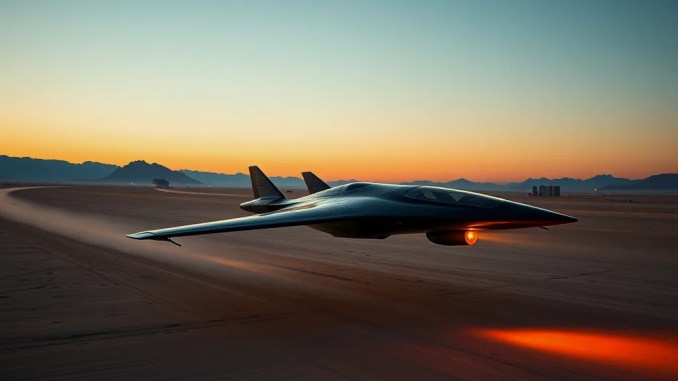
China’s Reusable Spaceplane Appears in First High-Resolution Satellite Photo
The US Defense Intelligence Agency (DIA) released a declassified assessment that includes a high-resolution Maxar satellite image showing a Chinese reusable spaceplane. The photograph reveals design elements — delta wings, cargo bay doors, a dark thermal protection surface and a rear section likely housing solar arrays — that closely match the form factor of the US X‑37B autonomous spaceplane. Analysts can now compare visible structural details with known flight profiles to infer likely mission options and on‑orbit capabilities.
Design and Flight Profile Parallels With This profile aligns with the X‑37B program’s approach. Differences in scale, surface layout and presumed payload interfaces suggest China’s craft likely aims to perform short to medium‑duration missions with flexible payload exchanges conducted via a cargo bay.
Operational Record: Four Missions Since 2020
DIA notes China has flown four spaceplane missions since 2020, with individual durations reaching up to nine months. The fourth vehicle launched in February remains in orbit. The publicly known cadence and durations indicate China has moved from technology demonstrations toward routine operations, which supports iterative improvements to avionics, thermal protection, and on‑orbit servicing hardware.
On‑Orbit Manipulation: Release and Recapture Demonstrated
Open orbit tracking compiled by Jonathan McDowell and others shows the Chinese spaceplane has released a small into satellite orbit and subsequently recaptured it several months later. Trackable events in June (release), July (recapture), and repeated episodes in August–September point to an ability to perform rendezvous, capture and release sequences. These actions imply either a robotic manipulator or an internal deployment/retrieval mechanism teamed with precise relative navigation sensors and guidance software.
Potential Mission Sets Enabled by the Spaceplane
The craft’s combination of cargo bay access, precise maneuvering and reusability enables several concrete mission types:
Satellite deployment and recovery: deliver and later retrieve small satellites for refurbishment, payload swap or return of experimental hardware.
On-orbit servicing and refueling demonstrations: practice docking, fuel transfer or electronics replacement to extend satellite life and test modular servicing interfaces.
Inspection and proximity operations: examine other satellites to collect imagery and sensor data or to verify their status; useful for diagnosing anomalies.
Manipulation of space objects: capture and reposition debris or nonfunctional satellites to reduce collision risk or to conduct controlled experiments.
How These Capabilities Differ From Conventional Satellites
Spaceplanes bring several operational advantages compared with fixed‑function satellites:
Maneuverability: the ability to perform significant plane changes and altitude adjustments allows targeted visits to multiple objects in a single mission.
Recoverability: returning payloads to the ground supports iterative hardware upgrades and post-flight forensics.
Payload versatility: a cargo bay supports experiments that require atmospheric return, modular servicing gear, or robotic arms for on‑orbit manipulation.
Weaponization Risks and DIA’s Directed Energy Assessment
DIA’s report also evaluates China’s development of counterspace systems. It highlights ground‑based directed‑energy weapons (DEWs) across multiple power classes intended to degrade or temporarily blind sensors, or to damage satellite components. The assessment warns that China could deploy higher‑power terrestrial lasers and potentially space‑based DEWs by late decade, posing risks to satellites in LEO and higher orbits.
Complementary Anti‑Satellite Tests and Fueling Demonstrations
The DIA summary references Chinese tests of ground‑launched anti‑satellite missiles and a reported fuel‑transfer demonstration near geostationary altitude (~36,000 km). Performing fuel transfer at geosynchronous maneuvering altitudes would represent a technical milestone, since it requires precise station‑keeping, long‑duration propulsion and sophisticated rendezvous control rarely demonstrated publicly by other states.
US and Russian Developments: A Broader Operational Context
The US operates two X‑37Bs and fields geosynchronous satellite inspections with enhanced maneuvering and refueling support. Pentagon officials have also acknowledged deploying space‑based systems with offensive and defensive roles. Russia continues developing on-orbit combat capabilities and, according to some US intelligence assessments, has considered extreme contingency options such as nuclear-tipped space systems. Collectively, these programs indicate major powers are expanding active, maneuverable and reusable capabilities in orbit.
Technical Indicators to Watch Next
Key observable indicators that will clarify the Chinese program’s trajectory include:
Launch cadence and duration trends: increasing tempo and longer missions imply maturation of life-supporting avionics and reusable thermal systems.
Frequency of release/recapture cycles: repeated manipulation events would confirm reliable robotic interfaces and mature relative navigation algorithms.
Orbit envelope expansion: activity beyond LEO toward higher altitudes or geosynchronous transfer would signal ambitions to operate near high‑value assets.
Signatures of laser testing: correlated outages, sensor saturation reports or open‑source detections of high‑power ground lasers could validate DIA’s DEW concerns.
How Analysts and Operators Can Respond Practically
Space operators and analysts should take several concrete steps to mitigate risks and leverage information:
Track and catalog maneuvers: integrate multiple tracking sources to detect rendezvous windows, enabling protective operational postures for vulnerable assets.
Harden critical sensors: implement redundant sensor modes and pointing protection to reduce vulnerability to dazzling or jamming from DEWs.
Design modular servicing interfaces: adopt standardized grappling and refueling interfaces so allied servicing assets can assist compromised satellites.
Establish norms and transparency measures: expand multilateral dialogues to define acceptable prox‑ops behavior, deconfliction protocols and incident investigation processes.
Nomenclature and Public Labels
Western outlets often call this Chinese vehicle “Shenlong,” referencing earlier robotic spaceplane work, while Chinese state media uses “Chongfu Shiyong Shiyan Hangtian Qi” (CSSHQ), translated as “reusable” experimental space vehicle.” The official name remains unconfirmed, but consistent labeling across open sources helps analysts collate flight histories and component inferences.
Bottom Line: Practical Implications for Space Operations









Be the first to comment