CRRC Unveils Cutting-Edge Rail Technologies at InnoTrans 2026
In an era where the push for sustainable and intelligent transportation accelerates, CRRC, China’s leading rail manufacturer, has showcased revolutionary advancements at InnoTrans 2026. Visitors and industry experts alike witnessed two groundbreaking concepts: the Velforce, an innovative hydrofuel-powered locomotive, and Vellink, a futuristic driverless metro system. These innovations not only push the boundaries of current rail technology but also set new standards for efficiency, safety, and environmental responsibility.
Hydrogen Fuel Cell Locomotive: Velforce Sets a New Standard
The Velforce locomotive embodies CRRC’s commitment to renewable energy by integrating a hydrogen fuel cell system into its design. Unlike traditional diesel engines that emit pollutants, Velforce utilizes a hydrogen-powered energy source that produces only water vapor, drastically reducing carbon emissions. This shift marks a pivotal move towards decarbonizing rail freight and passenger services worldwide.
The Velforce system is built on CRRC’s modular Xuan platform, allowing for flexibility and scalability across different locomotive models. The key component lies in its six-axle configuration, which optimizes weight distribution and traction capabilities for various operational demands.
Technical Specifications and Performance Insights
- Power Output: 2,000 kW, generated by advanced hydrogen fuel cells.
- Battery System: A high-capacity, 600 Ah Lithium-Titanate (LTO) battery pack complements the fuel cell, enabling energy storage, regenerative braking, and smoother operation.
- Energy Storage Capacity: 1,260 kWh, facilitating extended operations and rapid response to power demands.
- Operational Weight: 138 tons, designed to balance strength and agility on various terrains.
- Maximum Speed: Capable of reaching 100 km/h, illustrating its suitability for both freight and passenger services.
CRRC emphasizes that such a locomotive can operate sustainably over long distances without the need for re-fueling, thanks to its efficient hydrogen consumption and energy storage system. Maintenance routines are simplified using modular components, reducing downtime and lifecycle costs.
Design Innovations Promoting Safety and Efficiency
Velforce’s design prioritizes safety through redundant systems, real-time monitoring, and automated diagnostics. The hydrogen fuel cell modules are housed in sealed, fire-resistant compartments, mitigating risks associated with fuel leaks. The integration of regenerative braking allows the locomotive to recapture energy during deceleration, further enhancing efficiency.
Vellink: The Future of Autonomous Urban Rail
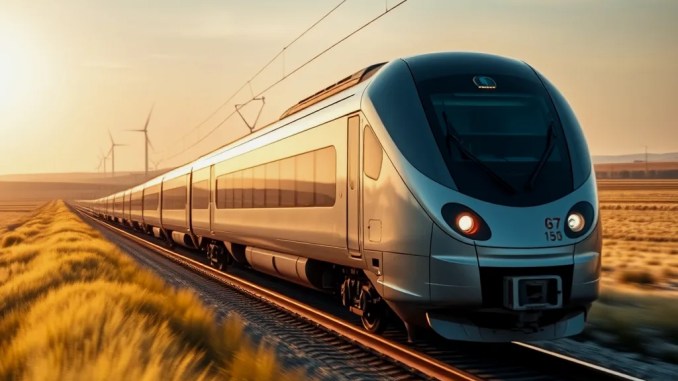
CRRC’s Vellink stands out as a manifestation of urban transit’s future — a fully autonomous, intelligent metro vehicle designed to redefine city mobility. Its sleek, futuristic exterior hints at a vehicle built for agility, safety, and passenger comfort.
Unlike traditional driver-operated trains, Vellink operates via autonomous control systems, which include advanced sensors, AI-based navigation, and fail-safe redundancies. This enables higher frequency, reduced operational costs, and improved safety standards in densely populated urban areas.
Design and Engineering Attributes of Vellink
- Material Use: The vehicle employs lightweight aluminum and innovative carbon fiber composites, significantly reducing weight and increasing energy efficiency.
- Structural Innovation: The car’s framework is designed for optimal weight distribution, with an emphasis on modularity for easy maintenance and upgrades.
- Aerodynamic Form: The streamlined shape minimizes air resistance, allowing for higher speeds and reduced energy consumption.
- Size & Capacity: Spanning 24.4 meters, Vellink accommodates up to 300 passengers comfortably, making it ideal for high-capacity urban routes.
Energy Efficiency and Sustainable Design
Vellink emphasizes sustainability through multiple approaches. The lightweight construction reduces energy requirements, while its electric drive system leverages clean energy sources. CRRC has integrated regenerative energy recovery technology to maximize efficiency during stops and acceleration.
Autonomous Operation and Smart Features
The Vellink runs on a sophisticated AI-based control system capable of real-time environment analysis, obstacle detection, and adaptive route planning. Redundant safety protocols ensure uninterrupted operation even in cases of sensor failure.
Impact on Urban Transit and Future Prospects
By deploying vehicles like Vellink, CRRC aims to revolutionize urban transit. Their autonomous operations can significantly reduce labor costs, improve service punctuality, and elevate passenger safety standards. Additionally, the focus on lightweight, energy-efficient materials aligns with global sustainability goals.
Why These Innovations Matter
Transitioning to hydrogen-powered and autonomous trains addresses pressing environmental concerns and urban congestion challenges. It signals a decisive step toward a cleaner, smarter, and more resilient rail infrastructure worldwide.
Conclusion
CRRC’s unveiling of the Velforce and Vellink at InnoTrans 2026 underscores a transformative era in rail technology. These advancements mirror the global shift toward sustainable, automated, and intelligent transportation systems. As they evolve from concept to reality, expect to see a profound impact on how cities and countries approach rail logistics and urban mobility for decades to come.
Frequently Asked Questions
What makes CRRC’s Velforce locomotive environmentally friendly?
Velforce uses hydrogen fuel cells, which produce only water vapor as a byproduct, drastically reducing emissions compared to traditional diesel locomotives.
How does Vellink’s autonomous system ensure safety?
Vellink integrates highly advanced sensors, AI-based navigation, and redundant safety protocols that enable it to detect obstacles, adapt routes, and maintain fail-safe operations.
Can these technologies be implemented in existing rail networks?
Yes, both Velforce and Vellink are designed with modularity and compatibility in mind, allowing integration into current rail systems with minimal disruption.
What are the future implications of these innovations?
These technologies could usher in a new standard for sustainable, efficient, and autonomous rail transport worldwide, reshaping urban mobility and freight logistics for decades to come.