UK Defense Investment Plan Announced

UK Defense Investment Plan Announced - RaillyNews

In a bold move to bolster national security and redefine its military capabilities, the United Kingdom’s Prime Minister Keir Starmer unveiled an ambitious Defense Investment Plan on June 30th. This strategic blueprint aims to inject an additional £15 billion into defense spending, signaling a pivotal shift towards modern military readiness aimed at confronting future conflicts. Understanding the Rationale Behind the Massive Funding Increase The UK government recognizes the increasing complexity of global threats — from cyber warfare to autonomous weapon systems. The plan’s core objective is to ensure the UK’s military remains competitive and technologically advanced. This funding surge not only addresses long-standing underfunding issues but also aligns with NATO’s targeted defense spending goals. Strategic Defense Spending Targets and International Commitments Starmer’s government commits to raising annual defense expenditure to approximately £80 billion by 2029. This figure will significantly surpass previous budgets, reflecting an intention to reach NATO’s guideline of 3.5% of GDP dedicated to defense. In a strategic move, the UK plans to bring this comprehensive defense strategy to the upcoming NATO summit in Ankara in July, signaling its commitment to collective security. The goal is to demonstrate the UK’s resolution to not only meet but exceed alliance expectations, thereby strengthening its role within the alliance. Key Elements of the New Defense Strategy The plan focuses on several critical pillars: – Enhancing deterrence capabilities through investments in autonomous systems and advanced weaponry. – Upgrading nuclear deterrence to maintain strategic stability. – Developing next-generation aircraft and digital defense infrastructure. – Fostering innovation in unmanned systems, especially kamikaze drones and AI-driven autonomous weapons. – Reforming defense procurement and logistics to ensure rapid deployment and sustained support. Implementation Steps and Future Projections The UK government has outlined a clear roadmap: a multi-year investment that involves massive equipment upgrades, research initiatives, and organizational reforms. The focus is on creating a more agile, technologically superior, and better-funded armed force capable of facing emerging threats. Recent policy discussions highlight that these investments will also generate significant domestic economic benefits, including job creation in defense manufacturing and technological innovation sectors. Specifically, the plan envisions £5 billion dedicated exclusively to developing new military technologies, emphasizing cutting-edge fields like AI, robotics, and cybersecurity. Impacts on Global Security and Alliances The UK’s commitment sends a powerful message to adversaries and allies alike: it is serious about maintaining strategic superiority. By leading in autonomous warfare and cyber defense, the UK positions itself as a key player in shaping future warfare doctrines. Moreover, the increased focus on collaborative defense development with NATO partners ensures joint readiness, collective deterrence, and shared technological advancements, ultimately strengthening the Western alliance’s resilience. Critical Public and Political Reception While some critics argue that such a substantial fiscal commitment could strain public finances or divert funds from domestic needs, defense advocates emphasize the long-term strategic gains and deterrence benefits. The plan also includes provisions for transparency and accountability, aiming to prevent misuse and ensure effective deployment of resources. Conclusion Starmer’s historic defense investment plan charts a new course for the UK, transforming its military into a state-of-the-art force ready for the 21st-century battlefield. As global tensions rise and technological warfare becomes commonplace, this comprehensive strategy aims to secure Britain’s place on the world stage, safeguard its interests, and uphold its commitments within NATO. For policymakers, defense strategists, and security analysts, this move underscores the urgent evolution required in modern defense—merging innovation, funding, and international cooperation on an unprecedented scale.
Germany and the Netherlands Order 69 More Armored Combat Vehicles - RaillyNews
EUROPE

Germany and the Netherlands Order 69 More Armored Combat Vehicles

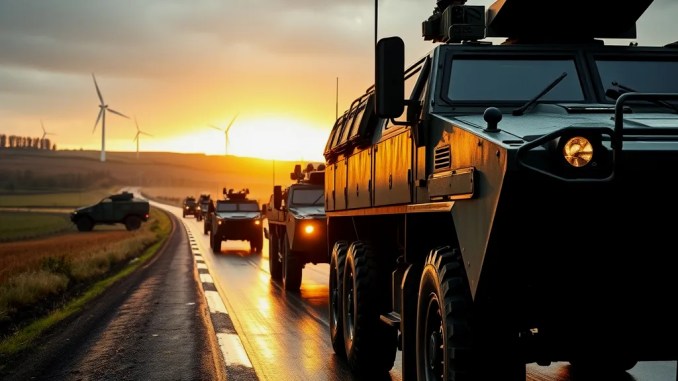
Germany and the Netherlands have exercised a procurement option to add 69 Boxer RCT30 (Schakal) vehicles to their joint program, bringing the combined order to 291 vehicles. OCCAR used the option included in the 2025 framework contract to place an additional order with ARTEC, the Rheinmetall–KNDS Deutschland joint venture that 🚄
Greece to Commission Seven New High-Speed ​​Patrol Boats for Coast Guard - RaillyNews
EUROPE

Greece to Commission Seven New High-Speed ​​Patrol Boats for Coast Guard

Seven 22-Meter MAGNAR 1950 Patrol Boats Contracted to Strengthen Greek Coast Guard Greece has contracted VIKING LIFE-SAVING EQUIPMENT HELLAS to construct seven MAGNAR 1950 fast patrol boats, each 22 meters long, under a €23.8 million procurement agreement. The deal, signed at a ceremony led by Minister of Maritime and Island 🚄
North Korea Unveils Ghost Aircraft with Flying-Wing Design - RaillyNews
ASIA

North Korea Unveils Ghost Aircraft with Flying-Wing Design

North Korea showcases a flying-wing platform that raises stealth and design questions The Unmanned Aeronautical Technology Development-2026 expo on 29 October 2026 displayed a previously unseen tailless aircraft with a flying-wing planform. State media released images showing a broad, blended structure with smooth leading and trailing edges. Observers noted canopy-like 🚄
€357.5 Million EU Funding Application for Rail Baltica - RaillyNews
EUROPE

€357.5 Million EU Funding Application for Rail Baltica

CEF Transport Funding Request and Timeline RB Rail AS lodged a targeted request for €357.5 million from the European Union to fund construction and infrastructure works for Rail Baltica between 2027 and 2030. The package splits into €157.5 million via the Cohesion Fund and €200 million from the General Fund. 🚄
Wuhan Launches Its First Circular Metro Line - RaillyNews
ASIA

Wuhan Launches Its First Circular Metro Line

Wuhan opens a continuous 59.9 km circular Line 12 that links seven central districts Wuhan Metro completed Line 12’s second phase on 29 October 2026, joining it with the first phase to form a fully underground 59.9-kilometer circular route with 37 stations. The full circuit takes about 96 minutes and 🚄
CMA CGM Launches Dedicated Block Train Service Between Mombasa and Nairobi - RaillyNews
AFRICA

CMA CGM Launches Dedicated Block Train Service Between Mombasa and Nairobi

Mombasa–Nairobi block train starts weekly 108-TEU imports service CMA CGM launched a dedicated block train service on 28 October 2026 linking Mombasa Port with the Embakasi inland container depot in Nairobi. The service runs once per week using 54-wagon trains capable of carrying 108 TEU of import containers per departure. 🚄
BNSF Reopens Railroad Lines in New Mexico - RaillyNews
AMERICA

BNSF Reopens Railroad Lines in New Mexico

Laguna-area floods knocked both Southern Transcon main lines out of service What happened: Intense rains around Laguna, New Mexico, produced flash floods that submerged track and rendered both Gallup sub’s main lines unusable. Sensors and on-the-ground inspections recorded roughly 8 inches (203 mm) of rain in three days in an 🚄
Global Mobility Surges in Siberian Espionage - RaillyNews
SCIENCE

Global Mobility Surges in Siberian Espionage

Overview of the Apr–Sep 2026 APT Landscape ESET researchers documented a clear acceleration in advanced persistent threat activity between April and September 2026. Nation-aligned groups from China, Russia, Belarus, Iran, North Korea and Middle East–linked actors maintained or expanded campaigns. Attack patterns shifted toward intelligence collection against state bodies, resumed 🚄
Ankara Train Station: 89 Years of the Capital's Memory - RaillyNews
Turkiye

Ankara Train Station: 89 Years of the Capital’s Memory

Ankara Train Station celebrates the 89th anniversary of its current building, continuing to serve as a central node in Turkey’s rail network and a living monument to the Republic’s early modern architecture. History and Design: How Ankara Train Station Was Built and Why It Matters Architect Şekip Akalın designed the 🚄