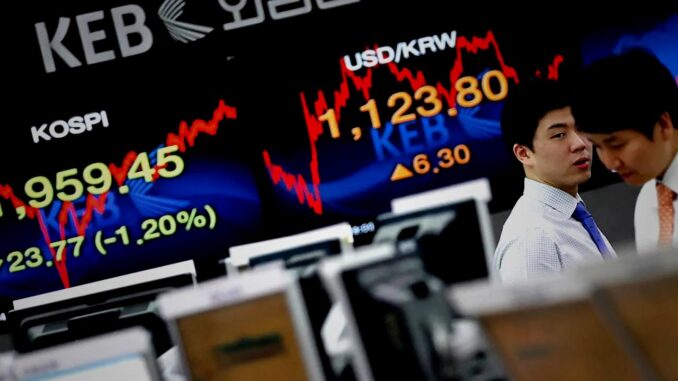
## KOSPI’s Rapid Rise and Sharp Decline: Analyzing Recent Market Movements The KOSPI, South Korea’s benchmark stock index, experienced an unprecedented surge followed by a significant downturn that has left investors and market analysts on high alert. This detailed analysis explores the timeline of recent developments, the factors behind the volatility, and what traders should watch for moving forward. ### The Journey to a Record High In early 2026, the KOSPI began its ascent from approximately 4,309 points. Consistent bullish momentum, supported by strong economic indicators and global investor confidence, propelled it upward. By June 22, 2026, the index reached an all-time high of 9,114 points—a remarkable achievement signaling robust market optimism. ### The Sudden Shift and Initiation of Profit-Taking However, markets are inherently volatile, and the KOSPI is no exception. After hitting its peak, a wave of profit-taking and sell-offs triggered a rapid correction. Investors, wary of overvaluation, began to divest aggressively, leading to a swift decline in the index value. ### Analyzing the Drop: From Peak to Current Levels Within just one month, the KOSPI lost approximately 33% of its value, plummeting from 9,114 points to around 6,856 points. This decline of about 2,258 points underscores the high volatility and the market’s sensitivity to economic signals and external shocks. ### Weekly and Monthly Performance Insights – Weekly: The index decreased by 8.41% over the past five days, reflecting heightened investor anxiety and rapid selling pressure. – Monthly: The overall downturn of 17.03% indicates a significant correction in what was previously seen as an overextended rally. ### The Bigger Picture: Is It a Correction or a Bearish Turn? Despite the steep fall, the KOSPI continues to trade at levels significantly higher than its starting point early in the year. The year-to-date (YTD) performance still reports an impressive 62.31% increase, illustrating resilience amid correction. Conversely, the one-year performance reveals a 115.92% gain, highlighting a period of substantial growth with recent volatility being part of natural market cycles. ### Factors Driving the Recent Volatility Several interconnected factors have contributed to this market turbulence: – Global Economic Uncertainty: Concerns over inflation, interest rate hikes, and geopolitical tensions have increased risk aversion. – Domestic Economic Data: Slower GDP growth and corporate earnings reports may have dampened investor enthusiasm. – Technological Sector Corrections: Overvalued tech stocks and startups have undergone substantial sell-offs, impacting broader indices. – Monetary Policy Adjustments: Central banks’ decisions to tighten monetary policy often trigger market corrections due to fears of slowing economic growth. ### Investors’ Strategy: Navigating the Volatility Amidst such tumult, prudent investors focus on long-term fundamentals rather than short-term fluctuations. Diversification, risk management, and staying informed about macroeconomic developments are key tactics. ### Future Outlook and Market Perspectives While the recent correction appears severely, it presents opportunities for value investing and positioning for subsequent rebounds. Analysts advise monitoring global economic indicators, geopolitical developments, and domestic policy changes to better anticipate future movements. ### Final Thoughts The recent KOSPI correction exemplifies market cycles—high gains often trigger profit-taking and correction phases. Staying disciplined, informed, and adaptable will be essential for investors aiming to capitalize on future rebounds in South Korea’s stock market. *Stay tuned to breaking updates and expert insights for navigating this ever-changing market landscape.*