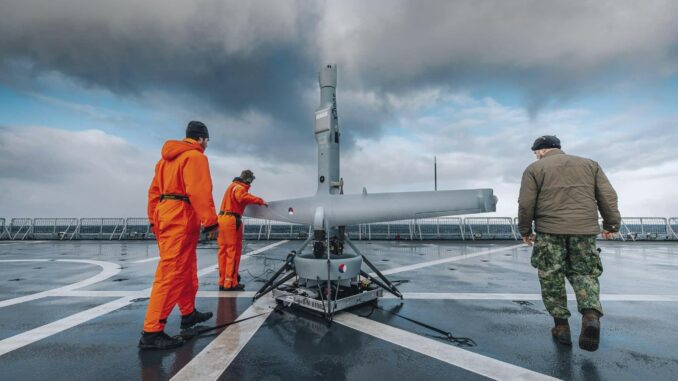
Revolutionizing Naval Operations with the V-BAT Drone
In a bold move to enhance maritime surveillance and combat capabilities, the Holland Navy recently conducted extensive tests of the V-BAT, an innovative vertical takeoff and landing (VTOL) drone developed by Shield AI. This testing phase, carried out during the Cold Response exercise off the coast of Norway, marks a significant step toward integrating cutting-edge autonomous systems into naval fleets worldwide.
Comprehensive Testing Off the Norwegian Coast
The Dutch Royal Navy deployed the V-BAT from the HNLMS Johan de Witt warship, subjecting it to rigorous trials designed to evaluate performance in challenging maritime environments. These tests focused on evaluating the drone’s reliability in various weather conditions, its ability to provide real-time imagery, and its effectiveness in target recognition. The results demonstrated that the V-BAT maintains high operational standards, even under adverse circumstances.
During the trials, operators successfully received live video feeds from the drone, enabling precise reconnaissance. The system’s capability to identify targets and analyze potential sea routes in real-time opened new possibilities for naval strategy and situational awareness. Given the success, the Dutch military quickly moved to secure an order for 12 additional units, aiming for full integration into their fleet by 2025.
Technical Superiority of the V-BAT Drone
Designed as a versatile, lightweight, and durable VTOL drone, the V-BAT offers the advantages of vertical takeoff, prolonged flight duration, and simple deployment without the need for runways or launch pads. Its dimensions include a 3.8-meter wingspan and a 2.9-meter height, which enable optimal flight efficiency while maintaining ease of transport and handling.
| specification | Details |
|---|---|
| Maximum Takeoff Weight | 73 kilograms |
| Payload Capacity | 18.1 kilograms |
| endurance | Over 10 hours |
| Operational Altitude | More than 5 kilometers |
| control | Two-person crew, fully autonomous capabilities |
Advanced sensors, including radar and electro-optic cameras, augment the drone’s surveillance capabilities. These platforms enable persistent monitoring, target tracking, and threat assessment, vital for modern maritime security.
The Strategic Advantage of the V-BAT
What makes V-BAT stand out in today’s drone landscape isn’t just its technical specs; It’s how seamlessly it integrates into naval operations. Its 10+ hour flight time allows continuous coverage of vast sea areas, a feature especially critical during extended missions or patrols.
Furthermore, the drone’s lightweight design and ease of operation—managed effectively by just two personnel—significantly reduces human resource demands. Its silence and low radar signature make it ideal for stealth missions, and its ability to operate from multiple ship classes enhances fleet flexibility.
Implications for NATO and Global Maritime Security
The successful deployment of the V-BAT drone by the Dutch Navy underscores a growing trend among NATO nations to adopt autonomous aerial systems. It enhances collective defense capabilities, allowing ships to detect threats at greater distances, monitor shipping lanes more effectively, and respond swiftly to emerging threats.
By bypassing traditional procurement hurdles through direct purchase agreements, the Netherlands positions itself at the forefront of military innovation. Other NATO allies are watching closely, as the integration of such systems could redefine naval warfare strategies, emphasizing intelligence, surveillance, and reconnaissance.
Operational Deployment and Future Prospects
The upcoming procurement plan includes equipping eight different ships with V-BAT units, contributing to a cohesive, ship-integrated surveillance network. As the 2026 NATO operational timeline approaches, the V-BAT’s deployment is expected to become a cornerstone of maritime patrol and reconnaissance missions.
In addition to defense, civil maritime applications such as search and rescue, environmental monitoring, and piracy prevention benefit immensely from the drone’s capabilities. The Dutch experience demonstrates how autonomous systems can elevate strategic readiness, responsiveness, and safety at sea.