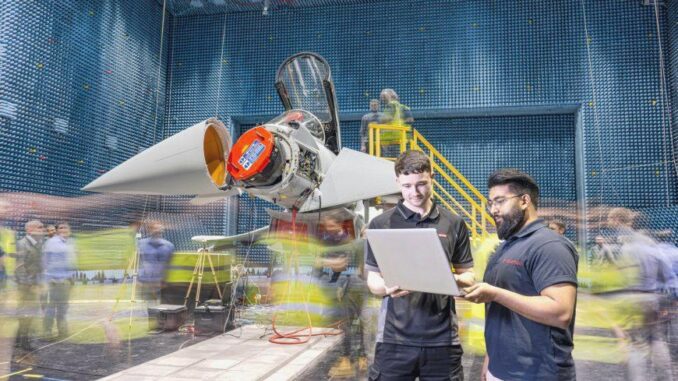
Britain’s Radar Revolution: How ECRS Mk2 Redefines Air Defense with Eurofighter Typhoon
In a bold move to safeguard skies and reshape defense exports, the United Kingdom is upgrading its Eurofighter Typhoon fleet with the next-generation ECRS Mk2 radar system. This is more than a hardware upgrade; It’s a strategic leap that elevates situational awareness, expands multi-target engagement, and fortifies electronic warfare capabilities. As global threats evolve and rivals invest in stealth, hypersonics, and AI-driven sensors, Britain’s commitment to a high-performance radar backbone signals a new era of air superiority, domestic innovation, and international leadership in defense technology.
Why ECRS Mk2 Matters: Core Capabilities and Strategic Impacts
The ECRS Mk2 radar replaces the legacy system with a more capable, agile, and interoperable sensor suite. Key advantages include:
- Enhanced Target Recognition: Expanded detection range and resolution enable pilots to identify and classify threats earlier, improving reaction time and reducing exposure to hostile activity.
- Coordinated, Multi-Target Tracking: Simultaneous tracking of multiple aerial contacts across large volumes of airspace enables precise threat prioritization and coordinated defense planning.
- Electromagnetic Warfare Readiness: Advanced electronic counter-countermeasures disrupt adversaries’ radar cues, complicating their targeting and preserving mission integrity.
These capabilities collectively underpin a robust air superiority posture across contested environments, from regional airspace patrols to high-end operations that blend cyber, space, and air components. The Mk2 upgrade also lays the groundwork for future sensor fusion, enabling seamless integration with data from satellites, airborne early-warning systems, and ground-based command nodes.
Funding, Partnerships, and the Global Competitiveness of UK Defense
The radar modernization effort is backed by a substantial investment, reflecting the UK’s strategic emphasis on homegrown defense industries and export competitiveness. The program channels hundreds of millions into research, development, and industrial capabilities, with a broader impact on employment, supplier ecosystems, and high-tech manufacturing across the country. Notably, collaborations with QinetiQ and other defense leaders accelerate integration, testing, and fielding while driving innovative solutions for complex radar challenges.
Beyond domestic gains, this modernization strengthens the UK’s position in global defense markets. The combination of cutting-edge radar technology, a proven platform like the Eurofighter Typhoon, and a robust industrial partnership network makes British technology attractive to international customers in the Middle East and beyond. Recent large-scale export activity—such as multi-aircraft sales with a total value reaching several billions—demonstrates sustained demand for modernized air defense capabilities, reinforcing the sector’s economic and strategic importance.
Strategic Collaborations that Power Modernization
Britain’s defense ecosystem hinges on deep collaborations with industry leaders. The Leonardo consortium and other prime contractors contribute critical radar components, avionics integration, and systems engineering that ensure real-time data fusion across platforms. These partnerships extend beyond radar to cover multi-role platforms, including advanced helicopters and next-generation aerospace solutions. Protecting regional industrial bases—such as the southwest England facilities—also secures jobs, talent pipelines, and regional economic vitality, reinforcing the UK’s innovation pipeline.
Geopolitical Stakes: Modernization Amid Evolving Threats
As defense landscapes shift, multi-domain operations demand sensors that can adapt to cyber, space, and electronic warfare domains. The ECRS Mk2’s emphasis on sensor fusion and networked warfare capabilities ensures Britain can contribute to allied C4ISR (command, control, communications, computers, intelligence, surveillance, and reconnaissance) architectures with confidence. This level of interoperability is critical for coalition operations, where shared situational awareness translates into faster decision cycles and more cohesive joint responses.
Fiscal Trajectory and Defense Budgetary Commitments
Looking ahead, the UK plans to sustain and grow its defense outlays, with a target to elevate overall defense spending to a defined share of GDP over the coming years. The ECRS Mk2 initiative embodies a high-value capital investment approach: modernizing key platforms, expanding domestic capability, and delivering export-ready technology that can scale to international customer needs. This creates a virtuous cycle where R&D feeds production, which in turn fuels more innovation and exports.
Future-Proofing: From Radar to Integrated Battle Space
The ECRS Mk2 is not an isolated upgrade but a foundational element of a broader Integrated Battle Space strategy. As artificial intelligence, machine learning, and advanced materials mature, Britain’s radar network will leverage real-time, AI-assisted decision support, predictive maintenance, and autonomous sensor platforms. These developments will enable the Typhoon fleet to operate with greater endurance, reach, and adaptability in contested skies.
Operational Scenarios: From Quick Reaction to Persistent Operations
In practice, the Mk2 radar enhances performance across several mission profiles. For quick-reaction intercepts, the system shortens kill-chain loops by delivering richer target data earlier in the engagement sequence. For persistent air defense, the fusion of radar with other sensors yields a scalable and redundant system that can cover extended patrols without sacrificing accuracy. The net effect is a more resilient, faster, and smarter air defense architecture.
Industry and Academic Synergy
Britain’s modernization program benefits from cross-sector collaboration between industry and academia. National laboratories, universities, and private firms combine to solve complex signal processing challenges, cooling and power efficiency needs, and ruggedized avionics for harsh operating environments. This synergy strengthens the country’s knowledge economy and ensures a continuous feed of skilled engineers into the defense sector.
Export Potential and Global Demand
The ECRS Mk2 upgrade catalyzes export opportunities for the UK defense industry. With a demonstrated capability to enhance radar performance dramatically, the UK can offer integrated sensor suites and platform-agnostic systems to allied nations seeking modernized air defense. Strategic marketing emphasizes cost-effective modernization, reliability, and comprehensive support—from initial integration to long-term maintenance and upgrades.
Conclusion: A Strategic Pivot Toward Superior Sensing
Britain’s move to retrofit the Eurofighter Typhoon with the ECRS Mk2 radar marks a pivotal shift in how the nation defends its airspace and shapes the global defense market. The combination of advanced target discrimination, multi-target tracking, and electronic warfare capabilities, embedded in a platform with proven agility, delivers a compelling edge. When paired with sustained investment, strong industrial partnerships, and a forward-looking R&D agenda, this radar modernization program positions the UK not only to deter modern threats but to lead in next-generation combat sensing and integrated air defense networks.